Board exams are crucial milestones in every student's academic journey. Scoring high marks in Class 10 and Class 12 depends not just on how much you study—but how smartly you revise. This is where a subject-wise revision strategy comes into play. Instead of randomly jumping between chapters or subjects, a structured plan tailored for each subject can maximize retention, reduce stress, and improve exam performance.
In this guide, you'll find everything you need—from subject-wise revision tips, important topics, to downloadable checklists and a practical timetable for your final exam preparation.
Each subject has a different pattern, scoring method, and learning style. For example:
That's why having a subject-wise revision strategy ensures:
Let's break down how to revise effectively for each subject:
Mathematics Revision Tips & Important Topics
Key Strategies:
Important Topics:
Bonus Tip:
Solve at least 20 MCQs and 2 long-answer questions from past years every day during your final month of revision.
Key Strategies:
Important Topics:
Bonus Tip:
Use NCERT line-by-line revision for Biology and practice writing balanced chemical equations for Chemistry.
Key Strategies:
Most Repeated Topics:
Bonus Tip:
Stick to NCERT keywords while writing answers to maximize marks.
Key Strategies:
Focus Areas:
Bonus Tip:
Use previous years' question papers to practice time-bound writing tasks.
Key Strategies:
Bonus Tip:
Make a revision notebook for "muhawre" (idioms), "lokoktiyan" (proverbs), and grammar rules.
Key Strategies:
Bonus Tip:
Revise output-based questions and database queries for scoring full marks in practical questions.
While chapter-wise revision is great during your early preparation phase, subject-wise revision is most effective in the last 30–45 days before the board exams. Here's why:
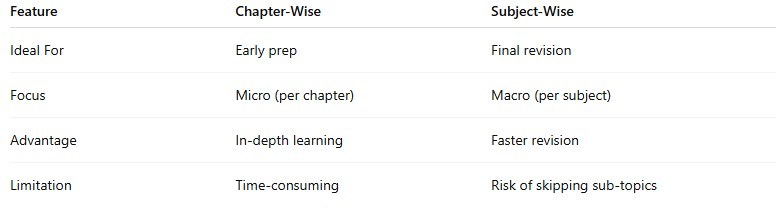
Use a hybrid approach: start chapter-wise and switch to subject-wise as exams approach.
Creating a personalized revision timetable helps ensure balance and accountability.
Sample Weekly Subject-Wise Plan (For Class 10):
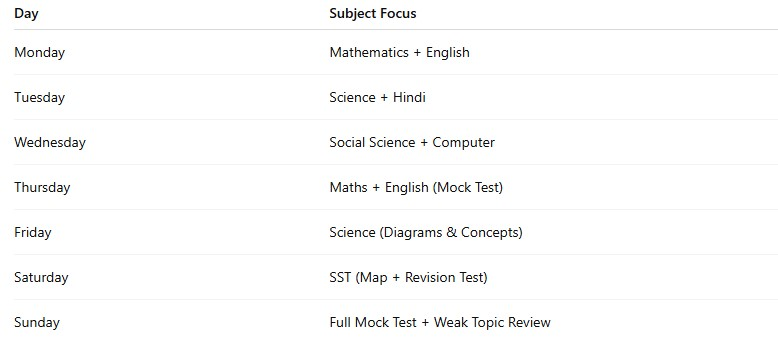
Use timed study sessions (e.g., Pomodoro – 25 min study + 5 min break) to avoid burnout.
Need a quick-print format of this subject-wise revision guide?
Subject-Wise Revision Notes
This includes:
Q1. When should I start subject-wise revision?
Start subject-wise revision at least 30–45 days before your board exams for best results.
Q2. How many hours per day should I dedicate to each subject?
Ideally, 2–3 subjects per day for 1.5–2 hours each. Avoid focusing on just one subject all day.
Q3. Is it okay to skip topics I find too hard?
Not advisable. Instead, prioritize them during early revision or get help from teachers/tutors.
Q4. Can I do subject-wise revision without coaching?
Absolutely! With a strong timetable, notes, and practice, self-study is enough to ace board exams.
A well-structured subject-wise revision strategy can be the difference between an average and an excellent score in your CBSE board exams. Customize the plan, stick to the timetable, focus on important topics, and practice enough mock tests to gain full control over each subject.
Your Class 10 or Class 12 board exam success isn't just about studying hard—it's about studying smart. And smart students revise subject-wise.

 Like| 2

 Comment





 591 Enrollment
 Validity 11 month,26 days


Introduction In today’s technology-driven world, semiconductors are at the heart of almost every electronic device, from smartphones and computers t
1254 followers

You have cleared your class 12 PCM with good scores and there are a lot of career opportunities that are right in front of you. Now the next most esse

555 followers

Indian Institute of Technology (IIT) is a Technical cum Research University. People who wish to become scientists and engineers give the JEE Mains and

469 followers

The Central Board of Secondary Education (CBSE) conducts board examinations for class 10th and 12th. 10th is generally school board but the 12th board
469 followers

Science is considered as one of the difficult subjects including both theory and practical application. Students of Class 7th learn to make working mo

16 followers

Introduction The International Day of Families is observed on the 15th of May every year. The Day was proclaimed by the UN General Assembly in 199

175 followers

NIACL AO stands for New India Assurance Company Limited Administrative Officer. It is a job role in the insurance sector where the selected candidates

214 followers

Nuclear weapons include missiles and bombs which are used to cause explosions. These nuclear weapons create disharmony among various countries. Countr
16 followers


 Copy Link