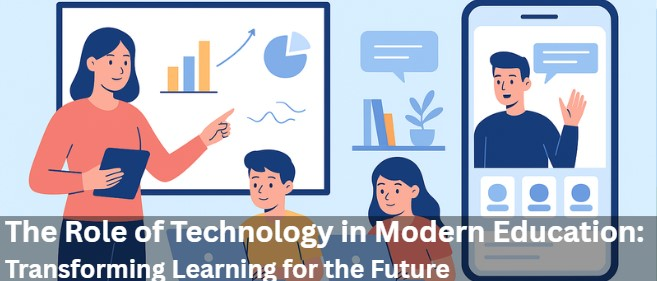
The world of education has changed dramatically with the rise of technology. From chalkboards to smartboards, and textbooks to tablets, the role of technology in modern education has become essential. It has not only simplified learning but also made it more interactive, accessible, and personalized.
Today's students are digital natives—they learn, communicate, and create using technology. This shift has redefined classrooms, teaching methods, and even how we think about education itself. In this article, we'll explore how technology is transforming modern education, its benefits, key tools, challenges, and what the future of digital learning looks like.
Education has always evolved with time. Decades ago, classrooms relied heavily on textbooks, blackboards, and lectures. The 1990s brought computers and the internet into schools, and the 2000s introduced e-learning platforms and digital resources.
Today, the use of technology in education has reached a new level. We now have:
This evolution shows how technology has moved from being a support tool to becoming the foundation of modern education.
Technology plays a critical role in improving the quality, accessibility, and engagement of education. Here are some major reasons it's so important:
Online platforms allow students from remote or underprivileged areas to access quality education. E-learning removes barriers of distance, language, and even disabilities through tools like screen readers and captions.
With the help of AI and data analytics, technology allows students to learn at their own pace. Platforms like Khan Academy and Coursera track progress and recommend content suited to individual learning styles.
Interactive videos, 3D animations, and virtual simulations make complex subjects easier to understand. For example, a physics experiment or a historical event can be experienced virtually.
Teachers can now use digital tools to create lesson plans, assess student progress, and use real-time analytics to identify learning gaps.
Through video conferencing, students can now connect with peers, experts, and educators worldwide—breaking geographical boundaries.
Here are the main technologies that are shaping the future of learning:
AI is revolutionizing education by enabling personalized learning paths, automating grading, and offering instant feedback. Virtual tutors like ChatGPT and Google Bard help students get explanations anytime, anywhere.
VR creates immersive environments for subjects like history or biology, allowing students to “experience” the past or explore the human body in 3D. AR enhances textbooks with interactive visuals, making learning more engaging.
Platforms like Google Classroom, Moodle, and Canvas help manage assignments, track grades, and facilitate communication between teachers and students.
Educational apps use game-like elements—points, levels, and badges—to make learning fun. This improves motivation and retention, especially for younger students.
Students can now access study materials, assignments, and notes from anywhere using cloud storage. This encourages flexibility and collaborative learning.
Smart classrooms use IoT devices like smart boards, attendance sensors, and connected projectors to enhance learning and classroom management.
Here's how technology is making education smarter and more effective:
Interactive content like videos, quizzes, and games keeps students interested and helps them understand topics better than traditional lectures.
Digital assessments allow students to receive instant feedback, helping them correct mistakes and improve continuously.
Students can learn anytime, anywhere—at school, home, or while traveling. This flexibility supports working professionals and distance learners too.
Online learning platforms reduce the need for physical materials and infrastructure, making education more affordable.
Technology-focused learning builds essential 21st-century skills such as digital literacy, critical thinking, problem-solving, and collaboration.
Educators can track student performance through data analytics and tailor lessons accordingly for better results.
Despite its advantages, integrating technology in education has some challenges:
Not all students have equal access to devices or internet connectivity, leading to inequality in learning opportunities.
Excessive screen time can cause tiredness, eye strain, and loss of concentration.
Online education involves storing personal data, which can be vulnerable to hacking or misuse.
Too much reliance on digital tools can reduce creativity, problem-solving skills, and face-to-face communication.
Some educators struggle to adapt to new technologies without proper training and support.
To make technology in education more effective and inclusive, here are some solutions:
The future of modern education will rely heavily on advanced technologies. Here's what to expect in the coming years:
AI will personalize learning, automate administrative work, and provide intelligent analytics for teachers.
Students will be able to earn degrees entirely online, studying from the best universities in the world.
Technology will support continuous learning, allowing professionals to upskill and reskill throughout their careers.
VR and AR will become common, making learning immersive and experience-based.
Paperless classrooms, online exams, and digital libraries will promote environmentally sustainable learning.
The role of technology in modern education is not just about convenience—it's about transformation. It has made learning more accessible, engaging, and inclusive. From AI tutors to smart classrooms, technology bridges the gap between traditional education and the future of learning.
However, while technology is a powerful tool, it should complement—not replace—the human touch in education. A balanced, inclusive, and responsible approach will ensure that students not only learn better but also grow into thoughtful, tech-savvy citizens ready to face the challenges of the digital age.
Technology helps make education more interactive, accessible, and personalized. It supports both students and teachers through tools like e-learning platforms, smartboards, and AI tutors.
It provides interactive resources, real-time feedback, and personalized study plans, which make learning more effective and enjoyable.
Challenges include the digital divide, lack of training, cybersecurity issues, and overreliance on screens.
The future involves AI-based learning, global online universities, immersive VR classrooms, and sustainable digital education.

 Like| 6

 Comment




Competitive Exam Preparation Platform A competitive exam preparation platform should offer content, guidance, and community support. Study24x7 combin

1254 followers

Question 1.In the following question, out of the four alternatives, choose the word which best expresses the meaning of the given word. CUPIDITY a.

SSC Preparation Strategies & S
1551 followers
The number of aspirants every year attempts for Government exams like SSC CGL. But only some of them are able to crack it. The ratio is relatively low

1012 followers

1. COVID-19 may impact growth, IMF warns G20 The International Monetary Fund (IMF) has warned that the CoVID-19 outbreak would hurt the already fr
1012 followers

In today’s section of the UPSC daily news we’re looking at recent developments and current affairs for UPSC students, around the Citizenship Amendment
1012 followers

UPSC exam is also known as the IAS exam or Civil Service exam. This exam is conducted by the Union Public Service Commission every year to recruit can

3 followers

It's not as easy as it seems to choose the best coaching institute anywhere in India. Candidates should focus on some of the major aspects given below
3 followers


 Copy Link