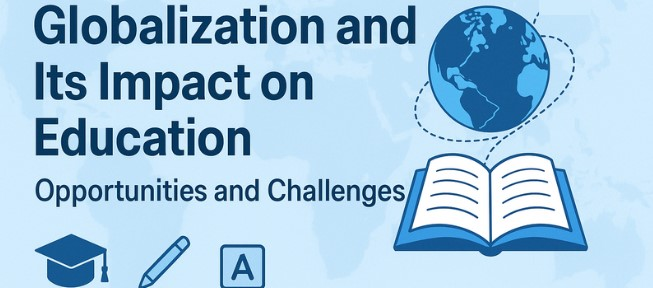
In the 21st century, the world is more connected than ever before. People, ideas, and technologies move freely across borders, creating what we call globalization. This global interconnectedness has transformed every aspect of life — from business and culture to communication and education.
The impact of globalization on education has been profound. It has expanded access to learning, encouraged cross-cultural exchange, and created new ways of teaching and learning. However, globalization also brings challenges such as inequality, brain drain, and cultural homogenization.
This article explores how globalization influences education, the opportunities it creates, the challenges it poses, and how the future of global education is taking shape.
Globalization refers to the increasing interaction and integration of people, companies, and governments worldwide. It's driven by advancements in technology, communication, trade, and transportation.
In simpler terms, globalization connects the world — making it easier for people to share information, goods, and ideas across countries.
When applied to education, globalization means the spread and exchange of educational ideas, systems, and technologies across borders. It allows students to learn from anywhere, teachers to collaborate globally, and institutions to set international standards.
Education is at the heart of globalization. As the world becomes more interconnected, education helps people adapt to global standards, learn new skills, and compete internationally.
At the same time, globalization influences education systems by encouraging:
Simply put, globalization and education feed each other — one drives progress in the other.
Globalization has opened up new possibilities for students, teachers, and educational institutions. Let's explore the major opportunities it brings.
In the past, students were limited to local or national institutions. Today, online platforms and international universities make high-quality education accessible to learners everywhere.
This accessibility is one of the biggest benefits of globalization.
Globalization encourages cultural exchange through international classrooms and exchange programs. Students interact with peers from different countries, gaining a broader worldview and better communication skills.
For example:
This helps develop empathy, understanding, and cooperation among future global citizens.
Globalization has introduced modern technology into classrooms. Smartboards, online resources, virtual reality, and AI-powered learning tools have made education interactive and engaging.
Teachers can collaborate globally, and students can access information instantly — something that was unthinkable decades ago.
Globalization promotes the standardization of education through international curricula and global benchmarks such as the IB (International Baccalaureate) and Cambridge programs.
This helps students move between countries without facing major academic differences, creating a more unified education system.
With a globalized education system, students develop skills that prepare them for international careers. Fluency in global communication, digital literacy, and intercultural competence are now key to employability.
A degree from a globally recognized university increases career prospects across borders.
Globalization has brought researchers from different parts of the world together. Shared knowledge and joint projects allow scientists, scholars, and institutions to tackle global issues like climate change, pandemics, and poverty.
For instance, global research collaborations between countries helped in the development of COVID-19 vaccines.
Global education produces skilled individuals who contribute to economic growth, innovation, and technological progress in their countries. Education also plays a vital role in promoting equality and social mobility worldwide.
While globalization brings opportunities, it also presents some serious challenges that need attention.
Not everyone benefits equally from globalization. Students in developing countries may lack access to digital resources, stable internet, or quality institutions. This creates a digital divide that separates privileged learners from the rest.
Talented students and professionals often move from developing countries to developed ones for better education and opportunities. This brain drain weakens local education systems and economies.
Globalization sometimes promotes Western educational models and languages at the cost of local traditions and cultures. As a result, native knowledge systems and regional diversity risk being overlooked.
Education has become a global business. Universities compete for international students, often prioritizing profit over quality. Rising tuition fees make global education inaccessible for many.
Overreliance on online platforms and technology can lead to reduced human interaction, limited practical learning, and even cyber risks. Not every subject can be effectively taught online.
Globalization often pressures educational systems to align with international standards. This can lead to loss of local autonomy and unique learning practices that once defined national education systems.
To make globalization work for education, it's important to balance global knowledge with local identity. Here's how countries can achieve that:
By doing so, globalization becomes a tool for growth rather than uniformity.
Technology is the driving force behind educational globalization. It enables e-learning, virtual classrooms, and global communication.
Here are some examples of how technology supports global education:
Technology ensures that education is no longer limited by location, making it a truly global experience.
Teachers have also been affected by globalization in several ways:
However, teachers also face challenges such as adapting to new technologies and managing diverse classrooms with students from different cultural backgrounds.
The future of education lies in global collaboration, technology integration, and sustainable learning.
Here's what's coming next:
The ultimate goal is to create an education system that's global in access but local in values.
Globalization has changed the face of education forever. It has connected teachers, students, and institutions like never before, offering access to global knowledge and new opportunities.
However, to truly benefit from globalization in education, countries must address its challenges — especially inequality, brain drain, and cultural loss.
The future of learning should embrace diversity while promoting innovation, sustainability, and inclusivity.
In short, globalization and education together have the power to build a smarter, more united world — one where learning truly knows no borders.
It refers to the worldwide integration of educational ideas, systems, and technologies, enabling global access to learning and collaboration.
It improves access to quality education, encourages cultural exchange, supports technological growth, and prepares students for global careers.
Challenges include inequality, cultural loss, brain drain, and commercialization of education.
Technology enables e-learning, online collaboration, virtual classrooms, and global communication between students and teachers.
It will focus on hybrid learning, AI-based education, sustainability, and global partnerships to ensure equal learning opportunities for all.

 Like| 4

 Comment





 4 Enrollment
 Validity Unlimited
Permafrost is any ground that remains completely frozen—32°F (0°C) or colder—for at least two years straight. These permanently frozen grounds are mos

302 followers

As per the expert analysis World history holds a very good position in UPSC 2020 Examination, so in this article we are going to discuss the topic
1012 followers

Name of Post : Rajasthan RPSC RAS / RTS Pre Exam Additional Result, Mains Exam Date, Pre Marks, Mains Result 2020 Result date : 09 July 2020

750 followers

The UPSC 2020 Schedule is the first and foremost step for all the candidates who wish to appear for the IAS civil services exams. All the candidate
1012 followers

UPSC is the most prestigious exam that aspirants give in order to become an IAS. The level of this exam is quite tough and not many aspirants clear th
1012 followers

Now, as the MPPSC exams are coming very soon, the students are trying to search the essential topics. All the topics related to English or the general
1012 followers

EU Parliament set to vote on Kashmir, citizenship Act The European Parliament is getting ready to decide on as many as 6 resolutions around Ind
1012 followers

The Jallianwala bagh massacre is one of the most inhuman incidents that took place in Indian history. This event depicts the most tragic and dark side
1012 followers


 Copy Link