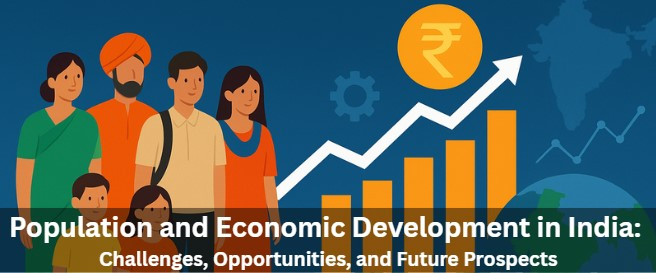
Population and economic development in India are deeply connected. India, home to over 1.4 billion people, has one of the largest and fastest-growing populations in the world. This growth brings both challenges and opportunities. A large population can support rapid industrialization, innovation, and a strong labor force. At the same time, if not managed well, it can strain resources, increase unemployment, and slow economic progress.
Understanding how population growth affects economic development in India is crucial to achieving sustainable progress. India's demographic structure — its youth population, urbanization rate, and workforce potential — plays a key role in shaping its economy today and in the decades to come.
Economic development refers to the process of improving people's standard of living through income growth, education, health, and infrastructure. Population, on the other hand, provides both the labor that drives production and the demand that fuels consumption.
In India, the population acts as both a driver and a challenge for economic development. When the population grows with sufficient education and job creation, it leads to a demographic dividend — a period when more people are working than dependent. But if jobs and resources do not grow equally, the population becomes a burden, leading to poverty and inequality.
These figures show that India's demographic profile is shifting. With a growing youth population, the country has a huge potential workforce. If properly trained and employed, this can make India one of the strongest economies globally.
a. Expanding Labor Force
A large population provides a huge labor force, which is essential for manufacturing, agriculture, and the service industry. This helps maintain competitive wages and boosts production.
b. Rising Domestic Demand
More people mean more demand for food, housing, education, transport, and technology. This domestic demand supports businesses, increases investment, and drives GDP growth.
c. Innovation and Entrepreneurship
India's young and tech-savvy population contributes to innovation and start-ups. Cities like Bengaluru, Hyderabad, and Pune are hubs for new ideas in IT, biotechnology, and AI.
d. Global Economic Role
India's large population also positions it as a major global market. Many international companies invest here because of the huge customer base and skilled workforce.
While population growth supports economic activity, unchecked or uneven growth can create serious challenges.
a. Unemployment and Underemployment
India's economy struggles to create enough jobs for millions of young people entering the workforce each year. Many end up in low-paying or informal jobs.
b. Pressure on Resources
Rapid population growth increases demand for water, energy, and food. Environmental degradation and resource depletion become significant issues.
c. Poverty and Inequality
Despite economic growth, income inequality remains high. Large populations in rural and semi-urban areas still lack access to quality education, healthcare, and employment.
d. Urban Overcrowding
Cities face challenges like housing shortages, traffic congestion, pollution, and slums due to uncontrolled migration from villages.
e. Education and Skill Gap
A growing population is beneficial only when people are educated and skilled. India's education system still struggles to provide employable skills to millions of youths.
The Indian government has implemented various policies and programs to balance population growth with economic progress.
a. National Population Policy (2000)
It focuses on providing reproductive health services, reducing infant mortality, and promoting awareness of small family norms.
b. Skill India Mission
Launched in 2015, it aims to train millions of youths in employable skills and make them ready for domestic and global jobs.
c. Make in India
Encourages manufacturing and attracts foreign investment, creating new employment opportunities.
d. Digital India
Promotes digital literacy, connectivity, and e-governance, enabling economic inclusion.
e. National Education Policy (NEP) 2020
Focuses on improving education quality, skill development, and research to prepare India's youth for the global economy.
India's demographic dividend is one of its biggest advantages. With a large portion of the population being young and productive, the potential for economic growth is massive. However, this dividend can only be realized through:
Countries like Japan and South Korea achieved rapid economic growth by investing in their population's education and productivity. India can do the same by converting its demographic dividend into real economic gains.
a. Technological Advancement
India's growing IT sector and digital economy are strong engines for future growth. Automation, AI, and renewable energy sectors can provide millions of skilled jobs.
b. Urbanization and Infrastructure Growth
Urbanization supports industries, real estate, and modern transport systems. Government projects like Smart Cities Mission and Bharatmala are examples.
c. Agricultural Modernization
With new technologies, precision farming, and better irrigation systems, India can boost productivity and rural income.
d. Green and Inclusive Growth
Balancing economic growth with sustainability will help India meet its environmental goals and improve quality of life for all citizens.
India's future depends on how well it manages the balance between population growth and economic development. If investments in education, healthcare, and employment continue, India could become the world's third-largest economy by 2030.
Some important focus areas for the future include:
India can learn from countries that successfully turned population growth into an advantage:
By combining population management with skill development and economic reforms, India can follow a similar success path.
Conclusion
The relationship between Population and Economic Development in India is both complex and full of potential. A growing population, if educated and employed productively, can become the driving force of economic progress. However, without proper planning, it can create unemployment, poverty, and inequality.
India's journey toward sustainable development depends on how effectively it balances population control, resource management, and human capital development.
With strong policies like Skill India, Digital India, and Make in India, the country is already moving in the right direction.
In the end, Population and Economic Development in India must progress together — because when people grow with opportunities, the nation grows with them.

 Like| 6

 Comment





 1548 Enrollment
 Validity Unlimited
If you are not appearing for the CSE 2023 and are planning to prepare for the UPSC 2024 exam, then you can check important details given in the UPSC a

3 followers

Mughal Empire The Mughal Empire (Urdu: مغلیہ سلطنت, romanized: Mughliyah Saltanat),[9] (Persian: مغلیہ سلطنت, romanized: mug͟hliyah saltanat)

573 followers

Ahead of the Republic Day weekend, we’re waiting for a clear response around the Citizenship Amendment Act, the promised Mumbai 24*7 and a strategic c

1012 followers

A panchdhatu idol is very precious, and many priests suggest having one in your home. It is an idol made by five different metals in the murti. T
1012 followers
भारत के उपराष्ट्रपति वेंकैया नायडू ने 05 जुलाई 2020 को भारत में अपना पहला सोशल मीडिया ऐप एलिमेंट्स (Elyments) लॉन्च कर दिया है ये ऐप शुरुआत में 8
30 followers

Reading up current affairs for UPSC exam? The UPSC news-based portion tests the abilities of a student to correlate the daily news with government pol
1012 followers

The IAS prelims will be conducted on 27th June 2021 and so now is the time to gear up for the exam with detailed preparation. Aspirants who wish to cl
1012 followers

Current Affairs Play crucial role in Civil Service Exam next year UPSC 2020, Here are one of the most important day observe in Indian Content,
1012 followers


 Copy Link