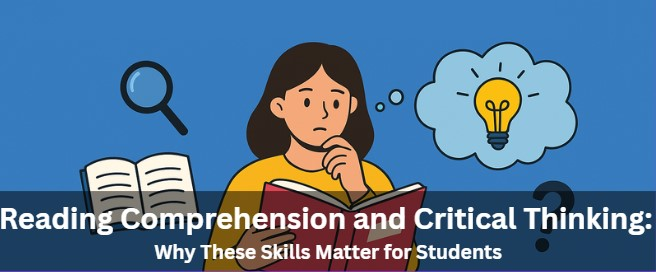
Reading comprehension and critical thinking are two of the most important skills students need in today's world. These skills help students understand information, analyze ideas, answer questions smartly, and make better decisions. Whether it's a school exam, a competitive test, or real-life communication, reading comprehension and critical thinking play a major role. When students read carefully and think deeply, they not only understand what is written but also connect ideas, solve problems, and understand the world better.
Reading comprehension means understanding what you read. It involves more than just reading words. It requires a student to:
Good reading comprehension helps students learn faster and score higher in exams because most subjects depend on reading and understanding.
Reading comprehension is not only for English. Subjects like science, social studies, mathematics and even computer studies require reading chapters, understanding concepts, and solving questions.
Competitive exams like CUET, CLAT, SSC, banking, UPSC, and SAT include reading comprehension passages. Students who understand text quickly can answer questions faster and more accurately.
Reading teaches the mind to focus. When students understand the meaning behind the text, the brain stays active and information remains fresh.
With better reading comprehension, students learn new words, phrases, sentence styles, and ideas. This improves writing and speaking skills.
A student who reads well can learn new topics without depending on others. This builds confidence and self-discipline.
Critical thinking means analyzing information before accepting it. It teaches students to:
Critical thinking helps students make good decisions, understand reality, and avoid confusion or misinformation.
Critical thinking allows students to think clearly and find smart solutions instead of depending on memorization.
Students learn to think before they act. This improves academic performance and life skills.
When students question ideas and explore possibilities, they become more creative.
Critical thinking breaks big ideas into smaller parts. This makes learning complicated subjects much easier.
When students understand “why” behind concepts, their confidence increases. They participate more in class and exams.
Reading comprehension and critical thinking support each other. When students read carefully, they start thinking deeply. When they think deeply, they understand better.
Here's how they work together:
When students read a paragraph, they look for clues, ideas, and arguments. This builds analytical skills.
Critical thinking helps students understand hidden meanings, writer's purpose, opinions, and important messages.
Whether it's MCQs, long answers, essays, or interviews, these skills help students answer correctly and logically.
Competitive exams, corporate jobs, communication roles, science fields, and leadership positions all require strong comprehension and thinking abilities.
Students can identify whether information is true, biased, or misleading.
Deep thinkers communicate clearly, ask better questions, and express ideas confidently.
From choosing a career to solving personal problems, these skills guide students to think wisely.
With better thinking and understanding, students learn new topics quickly without confusion.
Even 15-20 minutes daily improves speed and understanding.
Write or think about the main points after reading a chapter. This sharpens memory.
Questions like
Note down new words and learn their meanings through examples.
Practice with school books, online passages, and test prep materials.
Instead of accepting everything, ask questions to understand reasons.
Look at issues from multiple angles.
Games like Sudoku, chess, and reasoning puzzles strengthen thinking.
Talking about topics helps you understand them better.
Check if information is factual, biased, or incomplete.
Provide books, articles, stories, and newspapers.
Questions like “What do you think?” help students think freely.
This helps students express ideas and listen to others.
Reading and thinking require calm, planned study time.
Connecting lessons with real situations improves understanding.
Reading comprehension and critical thinking are essential for exams like:
These exams test how well students understand, interpret and analyze information. Students with strong comprehension and thinking skills score higher and perform faster with accuracy.
They read, analyze, experiment, and question everything. This leads to discoveries.
They read news sources, evaluate facts, and think critically before reporting.
They understand problems deeply and find smart solutions.
They analyze cases, interpret information and think logically.
They solve questions, understand concepts and think independently.
Reading comprehension and critical thinking are important skills that help students succeed in school, competitive exams and daily life. Reading comprehension improves understanding, vocabulary and memory. Critical thinking strengthens problem-solving, decision-making and logical reasoning. When students develop both skills together, they learn faster, write better answers, understand complex topics and grow into confident thinkers.
These skills prepare students not only for academic success but also for future careers and personal growth. In a world full of information, students who read well and think smart will always stay ahead.

 Like| 5

 Comment





 206 Enrollment
 Validity 1 month,30 days
 461 Enrollment
Validity Unlimited
461 Enrollment
Validity Unlimited 


 0 Enrollment
Validity 3 month,1 day
0 Enrollment
Validity 3 month,1 day 
This is the right time to start preparing for UPSC 2020 exam. With the unpredictable nature of the exam, the more rigorously you prepare the better.

1012 followers

SSC GD exam stands for the General Duty Constable examination. This exam is conducted annually by the Staff Selection Committee for the recruitment of

SSC Preparation Strategies & S
1551 followers

The SSC CHSL exam is conducted for various posts in the Indian government such as Lower Division Clerk, Postal Assistant/ Sorting Assistant and so on.
SSC Preparation Strategies & S
1551 followers

UPSC stands for Union Public Service Commission. It is the premier recruiting agency of the Indian government that conducts a variety of civil serv

106 followers
The difference in CPI and WPI: Wholesale Price Index (WPI) and Consumer Price Index (CPI) are two widely used indexes to calculate the inflation in th

13 followers

1. No minority in Bengal will lose citizenship because of CAA: Shah Home minister Amit shah has launched a campaign against the Mamta Banerj
1012 followers
सऊदी अरब अमीरात (यूएई) ने हाल ही में जापान के सहयोग से मंगल ग्रह पर अपना अपना पहला इंटरप्लेनेटरी होप प्रोब मिशन शुरू किया. यूएई का मंगल ग्रह के लिए

30 followers

Most of the top Coaching Institutes IAS Institute charge an estimated cost of around 1.5 lakh or more for the IAS 1-year course. In this article, ther

3 followers


 Copy Link