The Nobel Prize is one of the world's most respected honors, awarded to people whose work has made life better for humanity. Every year, awards are given in fields like Physics, Chemistry, Medicine, Literature, Peace, and Economic Sciences. Understanding Nobel Prize winners and their contributions helps us appreciate how science, creativity, and courage shape our world. This article highlights major Nobel laureates, their groundbreaking work, and why their contributions remain important today.
The Nobel Prize was established by Alfred Nobel, the inventor of dynamite. In his will, he left his fortune to create awards for people who bring the greatest benefit to humanity. Since 1901, the Nobel Prize has recognized individuals and organizations whose ideas and efforts spark progress, save lives, or inspire society.
Each prize comes with a medal, a certificate, and a monetary award. But more importantly, it represents global respect and recognition for extraordinary contribution.
Let's explore each category and some of the most remarkable winners whose discoveries changed the world.
Physics Nobel winners have helped us understand light, atoms, space, energy, and even the origin of the universe.
Marie Curie was the first woman to win a Nobel Prize. She also became the only person to receive Nobels in both Physics and Chemistry. Her work on radioactivity changed medical science forever. Today, X-rays and cancer treatments exist because of her discoveries.
Einstein won the Nobel Prize not for his famous theory of relativity but for explaining the photoelectric effect, which laid the foundation for modern electronics. His work led to inventions like solar panels, lasers, and digital cameras.
Modern Nobel winners include scientists who discovered black hole formation, gravitational waves, and quantum technologies. These breakthroughs help improve communication, navigation, and astronomy.
Chemistry Nobel laureates have unlocked how molecules behave, helping create medicines, batteries, fertilizers, and even sustainable technologies.
Pauling explained chemical bonds and molecular structures. His work shaped modern chemistry and biology. He later won the Nobel Peace Prize as well, becoming one of the few people to receive two Nobel Prizes in different fields.
Zewail pioneered femtochemistry, allowing scientists to observe chemical reactions happening in extremely tiny time scales. This discovery improved material science and drug development.
Emmanuelle Charpentier and Jennifer A. Doudna won the Nobel Prize for developing CRISPR-Cas9, a gene-editing tool that can cure genetic diseases, improve crops, and revolutionize biotechnology.
This category honors discoveries that improve our understanding of the human body and lead to life-saving medicines.
Fleming discovered penicillin, the world's first antibiotic. This single discovery has saved millions of lives by treating infections that were once deadly.
These scientists uncovered the structure of DNA, opening the door to genetic engineering, medical research, and biotechnology.
Katalin Karikó and Drew Weissman created the technology behind mRNA vaccines. Their work allowed the world to respond to the COVID-19 pandemic quickly and effectively.
The Literature Prize honors writers whose words inspire societies and reflect human emotions, culture, and history.
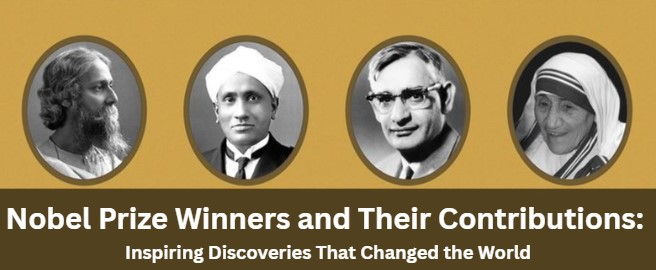
Tagore became the first Asian to win the Nobel Prize in Literature. His poetry and music, especially Gitanjali, continue to influence readers worldwide.
His magical realism in One Hundred Years of Solitude transformed modern storytelling.
Morrison's novels explored identity, family, and culture with deep emotional power.
Literature Nobel winners expand our thinking and help us understand the diversity of human experiences.
The Peace Prize recognizes people and organizations that fight for human rights, equality, and global harmony.
Mother Teresa received the Nobel Peace Prize for her compassionate work with the poor and sick in India. Her life remains a global symbol of kindness and service.
Dr. King won the Nobel Peace Prize for leading the nonviolent movement for civil rights in the United States. His speeches continue to inspire millions.
Malala is the youngest Nobel laureate. She advocates for girls’ education even after surviving an attack. Her courage made her a global symbol of hope.
This prize recognizes economists whose ideas improve economic policies, reduce poverty, or explain how markets function.
Sen's research connected economics with social justice. He developed the “capability approach,” helping governments create better policies for health, education, and welfare.
Kahneman introduced behavioral economics, explaining how emotions and psychology affect decisions. This changed marketing, finance, and policy-making.
Modern Nobel economists study climate change, gender inequality, development, and sustainable growth.
Nobel Prize contributions influence our daily lives in ways we often don't notice. Their discoveries:
Every Nobel-winning discovery shows how ideas can transform the world.
Studying Nobel Prize laureates helps students and young professionals:
Understanding how discoveries happen inspires creative thinking.
Most Nobel winners spent years exploring questions, failing, and trying again.
People from different countries, cultures, and fields have shaped humanity.
Their stories prove that dedication and effort can lead to meaningful change.
In recent years, Nobel Prizes have increasingly focused on:
These areas will shape the future of science and society.
Nobel Prize winners and their contributions have made the world safer, healthier, smarter, and more connected. Their work reminds us that great ideas can come from curiosity, passion, and persistence. Whether it's breakthroughs in physics, lifesaving medical discoveries, inspiring literature, efforts for peace, or economic insights, each Nobel Prize reflects the power of human innovation.
Learning about these achievements encourages students and readers to explore new ideas and contribute to society. The Nobel Prize continues to honor people who make a real difference — and their stories inspire the next generation to dream big and work for a better world.

 Like| 5

 Comment





 633 Enrollment
 Validity Unlimited


Previous year question paper will help you to get some ideas about the examination and eventually it will help you in SSC CGL 2020 Exam Question

SSC Preparation Strategies & S
1551 followers
आंध्र प्रदेश (एपी) के राज्यपाल विश्वभूषण हरिचंदन ने 31 जुलाई 2020 को राज्य सरकार के तीन राजधानी वाले योजना को मंजूरी दे दी है. आंध्र प्रदेश की जगनमोह

30 followers

In India online education business has started to boom lately, bringing online courses and live classes in trend. Online education business has become

1253 followers

Candidates have already started preparing for the next round of competitive exams. Do not worry if English isn't your first language. There are man
SSC Preparation Strategies & S
1551 followers

Defence Research & Development Organization (DRDA-RAC) has released the notification for the recruitment of Scientist-B on 167 posts. RAC invites onli

382 followers

Government Policies on Education in India Education has always been one of the top priorities of the Indian government. From providing universal acce
8 followers

Every year around 10 lakh candidates apply for the Civil Service exam with the dream of becoming an IAS officer but only a few of them finally crack t

3 followers

UPSC, SSC, IAS, BANKING, DEFENCE, RAILYWAY और अन्य सरकारी और प्रतियोगी परीक्षाओं की तैयारी करने वाले अभ्यर्थी दैनिक करंट अफेयर्स 2020 के अपडेट यहां पढ

2091 followers


 Copy Link