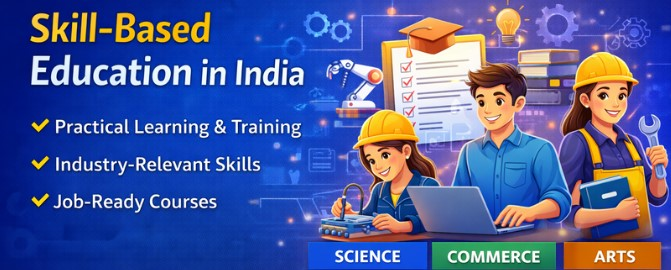
Education in India is evolving rapidly. Traditional learning methods focused mainly on theoretical knowledge, but modern industries demand practical skills and real-world experience. This shift has made skill-based education in India an important part of the education system.
Skill-based education focuses on teaching students practical abilities, problem-solving skills, and industry-relevant knowledge. Instead of only memorizing concepts, students learn how to apply their knowledge in real-life situations. Today, governments, educational institutions, and organizations are promoting skill development in India to prepare students for future careers.
This article explains the concept of skill-based education, its importance, benefits, government initiatives, and how it is shaping the future of Indian education.
Skill-based education is a learning approach that focuses on developing practical skills along with academic knowledge. It helps students gain the abilities required to perform specific tasks in professional environments.
Unlike traditional education, which emphasizes exams and theoretical learning, skill-based education encourages:
The main goal of skill-based learning in India is to make students job-ready and capable of contributing effectively to the workforce.
India has one of the largest youth populations in the world. However, many graduates struggle to find employment because they lack practical skills required by industries.
Skill-based education helps bridge the gap between education and employment.
Improves employability
Encourages entrepreneurship
Supports economic growth
Reduces unemployment
The Government of India has introduced several programs to promote skill development among students and youth.
One of the most significant initiatives is the Skill India Mission. It aims to train millions of young people in various skills that are relevant to industry requirements.
The program focuses on vocational training, entrepreneurship, and professional skill development.
Skill-based education includes several features that make it different from traditional academic systems.
These features make skill-based learning in India more effective in preparing students for modern job markets.
Many institutions now offer professional courses that focus on practical skills. These courses help students develop expertise in specific fields.
Vocational education is a major part of skill-based learning. It focuses on providing specialized training for specific professions.
Examples of vocational education include:
Vocational courses allow students to develop practical expertise and start working quickly.
These benefits make skill-based education in India an important part of modern education.
The future job market will be heavily influenced by technology and automation. Many traditional jobs are being replaced by advanced technologies.
However, new job opportunities are also emerging in areas such as:
Students who focus on developing modern skills will have better opportunities in these industries.
Educational institutions play an important role in developing students' practical abilities.
Schools and colleges can promote skill-based education by:
These steps help students gain practical experience while studying.
Despite its benefits, skill-based education in India faces several challenges.
Addressing these challenges will improve the effectiveness of skill-based education.
Students can start building skills even while completing school or college.
Here are some practical ways to develop professional skills:
Continuous learning and practice are essential for skill development.
The importance of skill-based education in India is increasing as industries demand skilled professionals who can adapt to changing technologies and work environments. Traditional education alone is no longer enough to prepare students for modern careers.
Skill-based learning focuses on practical knowledge, hands-on training, and real-world experience. Government initiatives, educational reforms, and industry collaboration are helping promote skill development across the country.
Students who invest time in learning practical skills along with academic studies will have better career opportunities and long-term professional success. As India continues to grow economically and technologically, skill-based education will play a crucial role in shaping the future workforce and empowering the next generation of professionals.

 Like| 5

 Comment





 0 Enrollment
 Validity 11 month,26 days


Preparing for CBSE Board Exams is one of the most crucial phases in a student's academic journey. Every student appearing for Class 10 and Class 12 bo

8 followers

Name of Post : Chhattisgarh CGBSE Board 10th, 12th Result 2020 Result date : 23 june 2020 Post Information : Chhattisgarh Board of Secondary

750 followers

Even though the registration for NEET 2020 will begin from 2nd December 2020, the buzz for NEET prep has already started among the students aspiring f

123 followers

National Eligibility cum Entrance Test (NEET) is one of the most recognized medical entrance exams in India for students who wish to study undergradua
123 followers

NEET full form is National Eligibility Cum Entrance Test which is conducted by CBSE for undergraduate admission in MBBS and BDS courses. Questions tha
123 followers

Chemistry holds a very important position in NEET Exam, so make your strategy accordingly with reference to topics. Here is one of the important topic
123 followers

Introduction The isolation of elements refers to the processes used to extract pure elements from their naturally occurring compounds, such as ores a
1253 followers

All you need to know about the BCom Statistics course. BCom statistics is a three-year course consisting of six semesters. This course allows stud

23 followers


 Copy Link