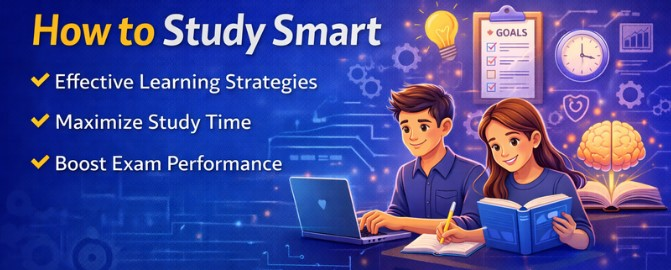
In today's competitive academic environment, students often believe that studying for long hours is the only way to achieve good results. However, the reality is different. Success in exams does not always depend on how many hours you study but on how effectively you study. This is where the concept of how to study smart becomes important.
Smart studying means using effective learning strategies, time management techniques, and focused study methods to understand concepts quickly and retain information for a longer time. Students who learn smart study techniques can complete their syllabus faster, reduce stress, and perform better in exams.
This guide explains practical strategies that help students study efficiently and achieve academic success.
Studying smart means learning in a way that improves understanding, saves time, and increases productivity. Instead of memorizing information blindly, students focus on understanding concepts, practicing regularly, and using effective study techniques.
Smart studying includes:
When students follow these strategies, they can improve both learning efficiency and exam performance.
Many students spend hours studying but still struggle to remember information during exams. This often happens because they rely on passive learning methods such as reading notes repeatedly.
Using smart study techniques provides several benefits.
These advantages show why learning how to study smart is essential for students at all levels.
The first step in smart studying is setting clear academic goals. Goals give direction and help students stay focused.
Students should create both short-term and long-term goals.
Clear goals help students stay motivated and track their progress effectively.
A structured study plan helps students manage their time effectively and avoid last-minute preparation.
A well-organized study schedule ensures that students cover the entire syllabus without feeling overwhelmed.
Active learning is one of the most effective smart study strategies. Instead of passively reading textbooks, students should actively engage with the material.
Active learning helps students understand concepts more deeply and remember them for longer periods.
The Pomodoro Technique is a popular time management method that helps students maintain focus during study sessions.
This technique improves concentration and prevents mental fatigue during long study hours.
Distractions are one of the biggest obstacles to effective studying. Smartphones, social media, and television can easily interrupt study sessions.
Students can reduce distractions by:
A distraction-free environment helps students maintain focus and productivity.
Visual learning techniques help students understand complex information quickly.
Examples include:
These tools help simplify difficult concepts and make studying more engaging.
Visual learning also improves memory retention, especially for subjects that involve detailed processes or relationships.
Note-taking is an important part of smart studying. Instead of copying entire textbook paragraphs, students should focus on writing key points and summaries.
Well-organized notes make revision easier before exams.
Revision is essential for long-term memory. Without revision, students may forget important information over time.
Students should follow a revision strategy such as:
Regular revision strengthens memory and improves exam readiness.
Practicing questions is one of the most effective ways to test understanding and improve exam performance.
Students should:
Mock tests help students identify weak areas and improve time management during exams.
A healthy routine plays a major role in improving study performance.
Students should focus on:
A healthy lifestyle improves concentration, memory, and overall productivity.
Consistency is the key to academic success. Studying a small amount every day is more effective than studying for long hours occasionally.
Students can stay motivated by:
Motivation helps students maintain discipline and continue improving their study habits.
During exam preparation, students should focus on efficient study methods.
These strategies improve confidence and performance during exams.
While learning how to study smart, students should avoid certain mistakes.
Avoiding these mistakes can significantly improve learning outcomes.
Learning how to study smart is one of the most valuable skills students can develop. Smart studying focuses on effective learning strategies, time management, and active engagement with study material.
By setting clear goals, creating a structured study plan, practicing regularly, and avoiding distractions, students can improve their understanding and achieve better academic results.
Smart studying is not about studying more hours but about studying in a more efficient and strategic way. With the right techniques and consistent effort, every student can improve their productivity, reduce stress, and succeed in their academic journey.

 Like| 5

 Comment





 1471 Enrollment
 Validity 11 month,26 days
 1141 Enrollment
Validity 5 month,27 days
1141 Enrollment
Validity 5 month,27 days 


Now, we are going to discuss the benefits that an individual may get after clearing the SSC CGL 2020. We all this will be a big chance for any indi

SSC Preparation Strategies & S
1551 followers

Uttar Pradesh Public Service Commission conducts the PCS exam. There are three stages of this exam: preliminary, mains and interview along with a defi

3 followers

Reference books help in getting useful information for students who aspire to prepare for their board exams. There are different reference books for

469 followers

Online Competitive Exam Preparation for Beginners Online competitive exam preparation has completely changed the way students in India study for gove

1254 followers

Now, as the MPPSC exams are coming very soon, the students are trying to search the essential topics. All the topics related to English or the general

1012 followers
प्रधानमंत्री नरेंद्र मोदी ने काकरापार परमाणु ऊर्जा संयंत्र-3 के सामान्य परिचालन स्थिति में आने पर 22 जुलाई 2020 को परमाणु वैज्ञानिकों को बधाई दी और

30 followers

The period following the completion of your 12th grade is a crucial juncture in your academic journey. It's a time when you must make a decision that
17 followers

Digital India and Skill Development India is rapidly transforming into a digitally driven economy where technology is reshaping every aspect of life.
8 followers


 Copy Link