The Constitution of India is not just a legal document. It is the foundation of our democracy and the protector of every citizen's freedom. One of its most important features is the Fundamental Rights, which guarantee equality, liberty, and justice to all.
These rights are often called the “Magna Carta of India” because they ensure that every person in the country is treated fairly and with respect. The Fundamental Rights in the Indian Constitution (Articles 12–35) form the backbone of democracy and protect citizens from the misuse of power by the government or others.
In this article, we'll explore the complete list of Fundamental Rights, their features, and importance—explained in simple language for students, competitive exam aspirants, and anyone interested in the Indian Constitution.
Fundamental Rights are basic human rights guaranteed by the Constitution of India to all citizens. They protect the dignity of individuals and help promote social, economic, and political justice.
These rights are essential for a person's overall development and cannot be taken away by the government except under specific conditions.
They are enforceable by the courts, which means that if someone's Fundamental Right is violated, they can go to the Supreme Court or High Court to seek justice.
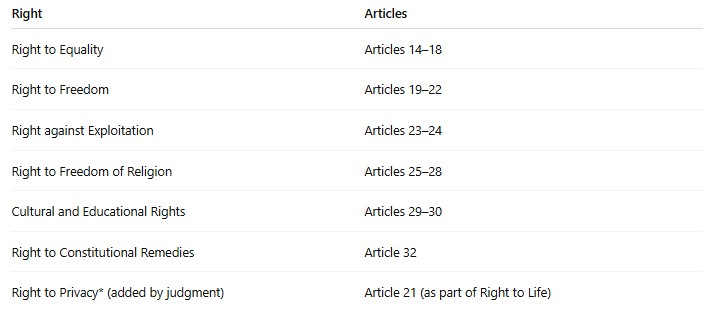
The Right to Privacy was recognized as a Fundamental Right by the Supreme Court in 2017 (Justice K.S. Puttaswamy case).
The Indian Constitution originally provided seven Fundamental Rights, but the Right to Property was removed in 1978 by the 44th Constitutional Amendment. Now, there are six Fundamental Rights guaranteed to citizens.
Let's understand each one in detail.
The Right to Equality ensures that all citizens are equal before the law and have equal protection of the laws. It prohibits discrimination on grounds of religion, race, caste, sex, or place of birth.
Key Provisions:
Example: The practice of untouchability is banned, and everyone has equal access to public places and jobs.
This right gives citizens the freedom to express themselves, move freely, and live without fear. It is one of the most important Fundamental Rights.
Key Provisions:
Example: Every citizen can speak freely or choose any job, but these freedoms are subject to reasonable restrictions for public order or national security.
This right protects individuals from being exploited or treated unfairly. It prevents practices like human trafficking and forced labor.
Key Provisions:
Example: Children under 14 years cannot be employed in dangerous industries.
India is a secular country, meaning everyone is free to follow, practice, and promote any religion—or none at all.
Key Provisions:
Example: A person can choose to follow Hinduism, Islam, Christianity, Sikhism, or any other faith freely.
India is home to many languages, cultures, and religions. These rights protect the interests of minorities and promote cultural diversity.
Key Provisions:
Example: Minority communities like Muslims or Christians can set up their own schools and colleges to preserve their culture and language.
This right allows citizens to approach the Supreme Court or High Courts if any of their Fundamental Rights are violated.
Article 32 is often called the “heart and soul of the Constitution” (as described by Dr. B.R. Ambedkar).
Remedies available:
Example: If a person is arrested without legal reason, they can file a Habeas Corpus petition in court.
The Fundamental Rights are vital for maintaining democracy and ensuring human dignity. Here's why they are important:
In short, these rights create a balance between individual liberty and social responsibility.
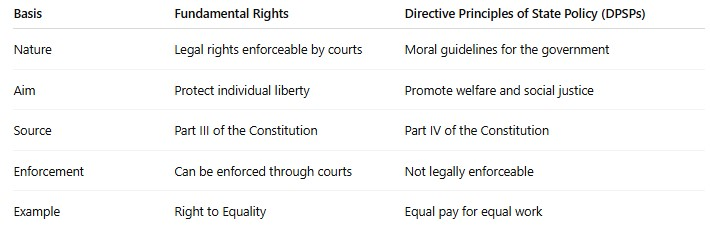
Both work together to ensure that India remains a welfare democracy—protecting rights while guiding policy.
1. Kesavananda Bharati v. State of Kerala (1973): Established the “Basic Structure Doctrine.” Parliament cannot change the basic structure of the Constitution, including Fundamental Rights.
2. Maneka Gandhi v. Union of India (1978): Expanded the meaning of “Right to Life and Personal Liberty” (Article 21).
3. Indira Gandhi v. Raj Narain (1975): Reinforced the importance of equality before law.
4. K.S. Puttaswamy v. Union of India (2017): Declared the Right to Privacy as a part of Article 21.
These changes show that Fundamental Rights evolve with society's needs and the changing times.
The Fundamental Rights of the Indian Constitution are the pillars of freedom, equality, and justice. They empower citizens to live with dignity and participate in democracy without fear.
These rights are not just legal guarantees—they are the moral foundation of India's democratic identity.
By understanding and respecting these rights, we ensure that India remains a nation of liberty, equality, and brotherhood.
In simple words, Fundamental Rights are what make India a truly free and democratic country.
1. How many Fundamental Rights are there in India?
There are six Fundamental Rights in the Indian Constitution (Articles 12–35).
2. Which Fundamental Right is called the “heart and soul” of the Constitution?
The Right to Constitutional Remedies (Article 32), as described by Dr. B.R. Ambedkar.
3. What are the six Fundamental Rights?
Right to Equality, Right to Freedom, Right Against Exploitation, Right to Freedom of Religion, Cultural and Educational Rights, and Right to Constitutional Remedies.
4. Which Article gives the Right to Education?
Article 21A provides free and compulsory education for children aged 6 to 14 years.
5. Can Fundamental Rights be suspended?
Yes, during a National Emergency, some rights (except Articles 20 and 21) can be suspended.

 Like| 5

 Comment







 0 Enrollment
 Validity 3 month
To clear the UPSC IAS exam, one of the most prestigious tests in India, it takes correct direction, the right approach, and quality materials. With th

5 followers

Is the IAS exam really tough? The difficulty level of the IAS exam is directly proportional to the level of preparation of an aspirant. A lot of hype

3 followers
1. UN rights body to move SC on CAA The Office of the High Commissioner for Human Rights (OHCHR) has announced that it will file a plea in the Ind

1012 followers

भारत का इतिहास कई हजार वर्ष पुराना माना जाता है।[1] 65,000 साल पहले, पहले आधुनिक मनुष्य, या होमो सेपियन्स, अफ्रीका से भारतीय उपमहाद्वीप में पहुंचे थे,

61 followers

Get ready and prepare yourself with the help of notes on significant themes for the UPSC 2020 common administrations test arrangement. These notes w
1012 followers
Well if you are planing to target UPSC 2020 Exam, than you should need to go for Daily news analysis with the help of this article we are trying to ma
1012 followers
Engineering Services Examination (ESE) is considered to be one of the toughest exams in India. There are many candidates who appear for the exam and y

17 followers

Government Jobs After Graduation Government jobs are among the most preferred career choices for graduates in India. Every year, lakhs of students pr
8 followers


 Copy Link