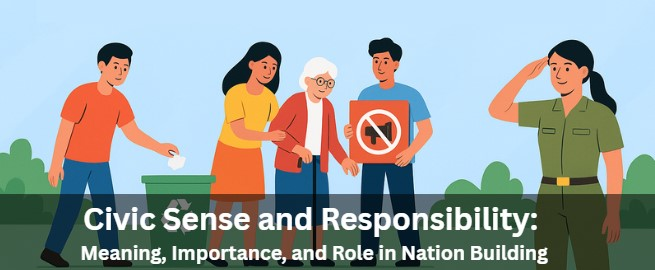
Civic sense and responsibility are two values that help societies grow in a balanced and peaceful way. When people understand how to behave in public spaces, treat others with respect, follow rules, and take responsibility for their actions, communities become safer and more organized. Civic sense plays a major role in developing a strong and progressive nation because it influences how citizens interact with one another and with the systems around them. In today's world, where cities are growing fast and people rely on shared public resources more than ever, understanding civic sense is important for everyone, especially students who play a key role in shaping the country's future.
This article explains the meaning of civic sense and responsibility, why they matter, examples of good civic behavior, and how these values contribute to nation building. It also covers practical ways individuals can develop better civic habits in their daily lives.
Civic sense refers to the basic rules of responsible behavior that individuals are expected to follow in public places. It includes respecting shared spaces, following laws, showing consideration for others, and taking actions that maintain harmony in society.
Some simple examples include:
Civic sense is not something that appears naturally. It must be learned, practiced, and encouraged at home, in schools, and through the community. It grows stronger when citizens understand that their actions affect everyone around them.
Civic responsibility means the duties and obligations a person has toward their country and community. These responsibilities help maintain a functioning society and ensure that people work together as responsible citizens.
Civic responsibilities include:
When citizens fulfill their civic responsibilities, it reduces conflict and creates a positive environment where development can happen more easily.
Civic sense is not a textbook concept. It is something people use every day. When people follow simple public rules, cities become cleaner and safer. For example:
Good civic habits like using dustbins, not spitting, and avoiding littering make cities healthier and more pleasant. Clean surroundings reduce diseases and improve everyone's quality of life.
Many traffic problems occur because of rule-breaking like jumping signals, driving on the wrong side, or parking carelessly. When drivers follow traffic rules, road accidents decrease and movement becomes smoother.
Civic sense includes being considerate. Whether it is giving up a seat for an older person, staying quiet in hospitals, or waiting your turn, respectful behavior improves social relationships.
Public property belongs to everyone. Breaking benches, damaging bus stops, or scribbling on walls is a lack of civic sense. When people take care of these facilities, the government can use funds for development instead of repairs.
Many arguments, misunderstandings, and conflicts can be avoided when people show patience, tolerance, and respect. Civic sense reduces social tension and promotes peaceful coexistence.
Many societies struggle with poor civic behavior due to different reasons. Some common causes include:
Understanding these reasons helps communities decide what changes are needed to improve civic habits.
Children learn civic values first at home. When parents show good behavior—like not littering or following rules—children observe and copy them. Schools also play an important role by teaching students about responsibilities, environmental awareness, and social behavior.
Teachers can encourage civic sense by:
When children learn these values early, they carry them into adulthood and help create a more responsible society.
Nation building is the process of developing a country socially, economically, and politically. Civic sense and responsibility directly support this development in several ways.
When citizens use public resources responsibly, roads, parks, government buildings, and utilities stay in good condition for longer. This reduces the need for constant repairs and saves money that can be used for progress.
A society where people follow rules has less crime and fewer disputes. This creates a safe environment where businesses can grow and citizens can live without fear.
Actions like saving water, planting trees, reducing waste, and avoiding pollution help protect natural resources. A healthy environment is essential for sustainable development.
Civic responsibility motivates people to participate in community programs, volunteer work, and decision-making processes like elections. Strong participation leads to better governance.
When people treat each other fairly and respect differences, social harmony improves. This unity helps the nation face challenges together and move forward.
A disciplined, responsible society attracts investment, improves tourism, and creates a positive image of the country in the world. This leads to better job opportunities and stronger economic growth.
Here are some simple, everyday examples that show how easy it is to practice civic sense:
Each small action contributes to a better community.
Improving civic sense requires participation from individuals, government, and institutions. Here are effective ways to increase civic awareness:
Campaigns on cleanliness, road safety, and environmental protection help citizens understand their duties.
Fines for littering, breaking signals, or damaging property encourage responsible behavior.
Local groups, NGOs, and resident associations play a key role in promoting civic responsibility.
When people see others practicing good behavior, they are more likely to follow.
Schools, colleges, and communities can organize drives to encourage participation and awareness.
Students should learn about public behavior and responsibilities as early as possible.
Young people have strong energy, creativity, and ideas. They can inspire others and lead positive changes. Students can practice and promote civic sense by:
The youth can spread the message faster and set an example for others.
Civic sense and civic responsibility are essential for building a peaceful, safe, and progressive society. When citizens understand their duties and treat public spaces with respect, the entire community benefits. A country grows stronger when people follow rules, care for the environment, respect others, and contribute to development. Civic sense may seem small, but it plays a powerful role in shaping the future of a nation.
To build a better and more united country, every citizen must practice simple acts of responsibility in daily life. These small steps lead to big changes and help create the strong, modern nation everyone dreams of.

 Like| 6

 Comment





 6 Enrollment
 Validity Unlimited
 0 Enrollment
Validity 3 month
0 Enrollment
Validity 3 month  0 Enrollment
Validity 3 month
0 Enrollment
Validity 3 month 
1.Rajya Sabha records 96% productivity Rajya Sabha, the upper house of the parliament has recorded 96% productivity in the current Budget session,
1012 followers

Youth Destination is the most affordable and one of the best IAS coaching in Delhi for Hindi medium and English as well. We believe to charge course f

3 followers
Hemant Soren sworn in as Jharkhand CM Hemant Soren, from the Jharkhand Janmukti Morcha (JMM) has been sworn in as the 11th Chief Minister for Jhar
1012 followers
The UPSC Personality Test, commonly known as the interview stage of the Civil Services Exam, is often considered the most decisive phase of the entire

1. AAP sweeps Delhi with 62 seats The Aam Aadmi Party, led by Arvind kejriwal had almost replicated its fairytale victory of 2015 by winning 62
1012 followers

Searching for how to join the UPSC coaching in Jaipur then you are in the right place. Here we are going to discuss how to join the UPSC coaching in J
3 followers

Looking for the best IAS coaching in Delhi NCR for the UPSC preparation then your research comes to an end here. There are a lot of choices to choose
3 followers

Punjab Public Service Commission (PPSC) has published a notification for the recruitment of Deputy Supdt. of Police, Tehsildar, Asst Registrar & Ot

382 followers


 Copy Link