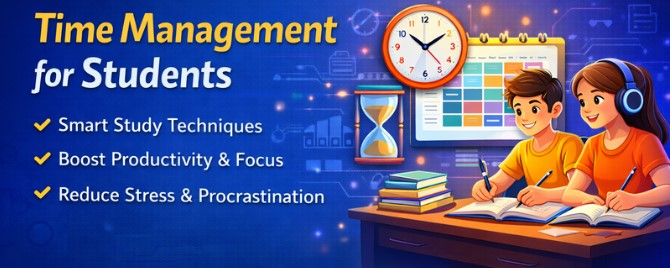
Time management is one of the most important skills every student should develop. With school assignments, exam preparation, extracurricular activities, and personal responsibilities, students often struggle to manage their time effectively. Learning time management for students can help improve productivity, reduce stress, and lead to better academic performance.
Many successful students are not necessarily the ones who study the longest hours. Instead, they are the ones who know how to use their time wisely and study efficiently. This guide explains practical time management strategies that can help students balance their studies and personal life while achieving their academic goals.
Students face multiple responsibilities every day. Without proper planning, it becomes easy to feel overwhelmed. Effective time management helps students organize their tasks and focus on what truly matters.
Improves academic performance
Students who manage their time well are able to complete assignments and revise subjects regularly.
Reduces stress and anxiety
Proper planning prevents last-minute pressure before exams or deadlines.
Builds discipline and responsibility
Time management teaches students how to prioritize tasks and stay committed to their goals.
Creates more free time
When tasks are organized efficiently, students can also enjoy hobbies, sports, and relaxation.
Many students struggle with time management due to poor planning or distractions. Understanding these challenges is the first step toward solving them.
Procrastination is one of the biggest obstacles to productivity. Students often delay difficult tasks and end up rushing before deadlines.
Mobile phones, social media, and entertainment platforms can easily distract students from studying.
Without clear academic goals, students may not know how to allocate their time effectively.
Many students start studying without a clear timetable, which leads to wasted time and incomplete tasks.
Recognizing these issues can help students take steps to improve their time management skills.
Effective time management begins with setting clear goals. Goals provide direction and help students stay focused on what they want to achieve.
Students should set both short-term and long-term goals.
When goals are clear, students can plan their time more effectively.
One of the most effective time management techniques for students is creating a study schedule.
A study schedule helps students:
Morning (5:30 AM – 7:00 AM)
Study difficult subjects like mathematics or science when the mind is fresh.
School hours (8:00 AM – 2:00 PM)
Pay attention in class and take clear notes.
Afternoon (3:00 PM – 5:00 PM)
Complete homework and revise school lessons.
Evening (6:00 PM – 8:00 PM)
Practice problems and work on assignments.
Night (8:30 PM – 10:00 PM)
Light revision or reading subjects.
Students can modify this schedule according to their personal routine.
Not all tasks are equally important. Some tasks require immediate attention, while others can wait.
Students should categorize tasks based on priority:
High priority tasks
Medium priority tasks
Low priority tasks
By focusing on high-priority tasks first, students can use their time more efficiently.
The Pomodoro Technique is a popular time management method that helps students stay focused.
The technique works like this:
This method helps maintain concentration and prevents mental fatigue.
Smartphones and social media are among the biggest distractions for students.
To manage time effectively, students should:
Creating a distraction-free environment significantly improves productivity.
Large tasks often feel overwhelming, which leads to procrastination. Breaking tasks into smaller steps makes them easier to handle.
For example, instead of planning to study an entire chapter, students can divide it into sections:
Small achievements motivate students to continue working.
Consistency is the key to effective time management. Instead of studying randomly, students should maintain a regular study routine.
Daily study habits help students:
Even studying for two to three focused hours daily can produce excellent results if done consistently.
Studying continuously for long hours can reduce productivity. The brain needs short breaks to stay active and focused.
Students should include short breaks between study sessions.
Healthy break activities include:
These activities refresh the mind and improve concentration.
Effective time management requires regular self-evaluation.
Students should ask themselves questions such as:
Reflecting on progress helps students improve their planning and productivity.
Exams require a different time management strategy. Students should focus on revision and practice during exam preparation.
Regular practice improves both confidence and speed during exams.
Good health plays an important role in effective time management.
Students should maintain healthy habits such as:
A healthy body supports better concentration and learning ability.
Staying motivated can be challenging during long study periods. Students can maintain motivation by:
A positive mindset helps students stay disciplined and productive.
Learning time management for students is essential for academic success and personal growth. By setting clear goals, creating a structured study schedule, avoiding distractions, and maintaining consistent study habits, students can make the most of their time.
Effective time management does not mean studying all day. Instead, it means studying smart, staying organized, and balancing studies with relaxation. Students who master this skill can reduce stress, improve academic performance, and achieve their long-term goals with confidence.
With dedication and proper planning, every student can develop strong time management habits and succeed both in school and in life.

 Like| 5

 Comment





Imagine yourself as a digital marketeer? The sunshine sector offers a chance to flex muscles in terms of online promotions, digital strategies, bui

35 followers

Sustainable Management of Natural Resources Objective: To understand the importance of managing natural resources sustainably. To explore various
1254 followers

How to Avoid Negative Marking in NEET 2025 Cracking NEET 2025 is not just about knowing the right answers; it's also about avoiding the wrong ones. N
1254 followers

The Uttar Pradesh Trained Graduate teacher is an examination that is conducted by the UPSESSB to recruit candidates for various posts of graduate-level teacher. This is an attractive opportunity for those who are looking to work under the government and teach in various government schools and colleg

68 followers

Online learning has been in the trend for quite a long period now. It has been widely accepted by parents, students, and teachers. In recent years the

544 followers

Adult education, different from child education, is a practice in which adults engage in a systematic education system the same as children do. Educat
544 followers

Reference books are considered to be the secondary material which the student refers to in case any doubt arises. These reference books are very impor

16 followers

The secondary sections i.e. classes 6th – 10th are the classes where students explore their interests, develop new ideas and try to choose a career in
16 followers


 Copy Link