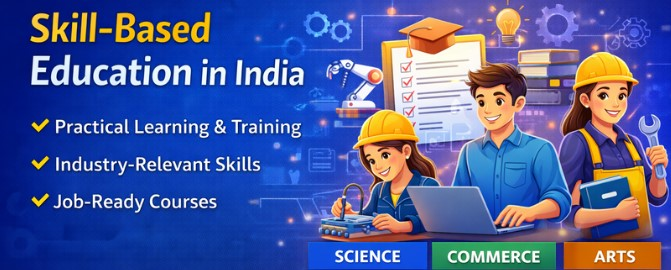
Education in India is evolving rapidly. Traditional learning methods focused mainly on theoretical knowledge, but modern industries demand practical skills and real-world experience. This shift has made skill-based education in India an important part of the education system.
Skill-based education focuses on teaching students practical abilities, problem-solving skills, and industry-relevant knowledge. Instead of only memorizing concepts, students learn how to apply their knowledge in real-life situations. Today, governments, educational institutions, and organizations are promoting skill development in India to prepare students for future careers.
This article explains the concept of skill-based education, its importance, benefits, government initiatives, and how it is shaping the future of Indian education.
Skill-based education is a learning approach that focuses on developing practical skills along with academic knowledge. It helps students gain the abilities required to perform specific tasks in professional environments.
Unlike traditional education, which emphasizes exams and theoretical learning, skill-based education encourages:
The main goal of skill-based learning in India is to make students job-ready and capable of contributing effectively to the workforce.
India has one of the largest youth populations in the world. However, many graduates struggle to find employment because they lack practical skills required by industries.
Skill-based education helps bridge the gap between education and employment.
Improves employability
Encourages entrepreneurship
Supports economic growth
Reduces unemployment
The Government of India has introduced several programs to promote skill development among students and youth.
One of the most significant initiatives is the Skill India Mission. It aims to train millions of young people in various skills that are relevant to industry requirements.
The program focuses on vocational training, entrepreneurship, and professional skill development.
Skill-based education includes several features that make it different from traditional academic systems.
These features make skill-based learning in India more effective in preparing students for modern job markets.
Many institutions now offer professional courses that focus on practical skills. These courses help students develop expertise in specific fields.
Vocational education is a major part of skill-based learning. It focuses on providing specialized training for specific professions.
Examples of vocational education include:
Vocational courses allow students to develop practical expertise and start working quickly.
These benefits make skill-based education in India an important part of modern education.
The future job market will be heavily influenced by technology and automation. Many traditional jobs are being replaced by advanced technologies.
However, new job opportunities are also emerging in areas such as:
Students who focus on developing modern skills will have better opportunities in these industries.
Educational institutions play an important role in developing students' practical abilities.
Schools and colleges can promote skill-based education by:
These steps help students gain practical experience while studying.
Despite its benefits, skill-based education in India faces several challenges.
Addressing these challenges will improve the effectiveness of skill-based education.
Students can start building skills even while completing school or college.
Here are some practical ways to develop professional skills:
Continuous learning and practice are essential for skill development.
The importance of skill-based education in India is increasing as industries demand skilled professionals who can adapt to changing technologies and work environments. Traditional education alone is no longer enough to prepare students for modern careers.
Skill-based learning focuses on practical knowledge, hands-on training, and real-world experience. Government initiatives, educational reforms, and industry collaboration are helping promote skill development across the country.
Students who invest time in learning practical skills along with academic studies will have better career opportunities and long-term professional success. As India continues to grow economically and technologically, skill-based education will play a crucial role in shaping the future workforce and empowering the next generation of professionals.

 Like| 5

 Comment




Medical exams are the exams that students give in order to get admission to top colleges & universities. These entrance exams are ranged from medium t

16 followers

Choosing the correct career after class 12th can be a daunting task. Many students are often confused as to which career is the right one for them. St
16 followers

Online learning has been in the trend for quite a long period now. Online classes have been widely accepted by parents, students, and teachers. In rec

13 followers

Optics: The Science of Light Optics, the branch of physics dedicated to the study of light, its properties, and its interaction with matter, has c
1254 followers

The term "business environment" refers to the sum total of all external and internal factors that affect a business. These factors shape the way a bus
1254 followers

Class 12 is one of the most important phases of a student’s life as after clearing this class they need to choose a career path for themselves. This c

555 followers

All you need to know about the BCom in Management Accounting and International Finance Course(IFA) BCom in Management Accounting and Internationa

23 followers

Daily Routine of NEET Toppers The National Eligibility cum Entrance Test (NEET) is one of the most competitive medical entrance exams in India. Every
1254 followers


 Copy Link