Cybersecurity as a Career: Skills, Opportunities, Salary, an - Study24x7
Social learning Network

Warning: include(./views/auth.php): failed to open stream: Permission denied in /var/www/html/live/loginRightSlider.php on line 18

Warning: include(): Failed opening './views/auth.php' for inclusion (include_path='.:/usr/share/php') in /var/www/html/live/loginRightSlider.php on line 18

Cybersecurity as a Career: Skills, Opportunities, Salary, and Future Scope

Updated on 12 March 2026
study24x7
Study24x7
36 min read 7 views
Updated on 12 March 2026

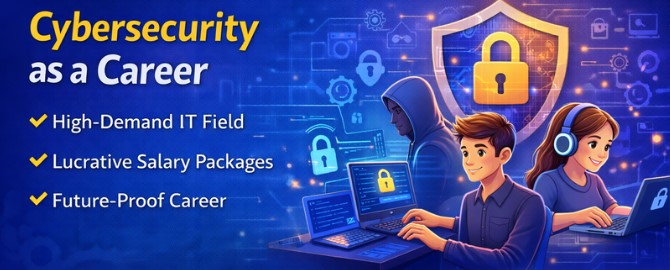
Cybersecurity as a Career

In today's digital world, protecting data and online systems has become extremely important. Businesses, governments, and individuals rely heavily on technology, which also increases the risk of cyber threats. Because of this growing demand, cybersecurity as a career has become one of the most promising and high-paying career options for students and professionals.

Cybersecurity focuses on protecting computer systems, networks, and data from cyberattacks such as hacking, malware, phishing, and identity theft. As organizations continue to digitize their operations, the need for skilled cybersecurity professionals is rising rapidly across the globe.

This article explains everything about cybersecurity careers, including required skills, education, job roles, salary potential, and future opportunities.


What Is Cybersecurity?

Cybersecurity is the practice of protecting digital systems, networks, and data from cyber threats and unauthorized access. It involves technologies, processes, and strategies that help prevent cybercrime and data breaches.

The field of cybersecurity includes several areas such as:

  1. Network security
  2. Application security
  3. Cloud security
  4. Information security
  5. Ethical hacking
  6. Digital forensics

Professionals working in cybersecurity ensure that sensitive information remains safe from hackers and cybercriminals.


Why Cybersecurity Is a Growing Career Field

The demand for cybersecurity professionals has increased significantly in recent years. Organizations store large amounts of sensitive data, making them targets for cyberattacks.

Several factors contribute to the rapid growth of cybersecurity as a career:

Increase in cybercrime

  1. Cyberattacks are becoming more frequent and sophisticated. Companies need experts to protect their systems from threats.

Digital transformation

  1. Businesses are moving toward cloud computing, digital platforms, and online services, which require strong cybersecurity measures.

Data protection regulations

  1. Many governments have introduced strict data protection laws, making cybersecurity an essential requirement for organizations.

Because of these factors, cybersecurity has become one of the fastest-growing career fields in the technology industry.


Skills Required for a Career in Cybersecurity

To build a successful career in cybersecurity, professionals must develop both technical and analytical skills.

Technical skills

Cybersecurity experts should have strong knowledge of:

  1. Computer networks
  2. Operating systems
  3. Programming languages
  4. Encryption technologies
  5. Cloud security

Programming languages such as Python, Java, and C++ are often useful for cybersecurity professionals.

Analytical skills

  1. Cybersecurity specialists must be able to identify potential threats and analyze system vulnerabilities.

Problem-solving ability

  1. Cyberattacks require quick responses. Professionals must think critically to prevent security breaches.

Communication skills

  1. Cybersecurity experts often work with teams and explain security risks to non-technical stakeholders.


Educational Path for Cybersecurity Careers

Students interested in cybersecurity as a career can pursue several educational pathways.

Bachelor's degree programs

Many universities offer undergraduate programs such as:

  1. Bachelor of Technology in Cybersecurity
  2. Bachelor of Computer Science
  3. Bachelor of Information Technology

These programs teach students the fundamentals of network security, programming, and information security.

Professional certifications

Certifications help professionals gain specialized cybersecurity skills. Popular certifications include:

  1. Certified Ethical Hacker (CEH)
  2. Certified Information Systems Security Professional (CISSP)
  3. CompTIA Security+

Certifications often improve job prospects and career advancement opportunities.


Popular Job Roles in Cybersecurity

Cybersecurity offers a wide variety of job roles depending on expertise and specialization.

Cybersecurity Analyst

  1. A cybersecurity analyst monitors networks, detects threats, and ensures that security systems are functioning properly.

Ethical Hacker

  1. Ethical hackers test computer systems by identifying vulnerabilities before malicious hackers can exploit them.

Security Engineer

  1. Security engineers design and implement secure network systems for organizations.

Digital Forensics Expert

  1. Digital forensics professionals investigate cybercrimes and collect evidence from digital devices.

Security Consultant

  1. Security consultants advise organizations on improving their cybersecurity infrastructure and protecting data.

These job roles make cybersecurity careers diverse and exciting for technology enthusiasts.


Industries That Hire Cybersecurity Professionals

Cybersecurity professionals are required in almost every industry that uses digital systems.

Major sectors hiring cybersecurity experts include:

  1. Banking and financial services
  2. Government agencies
  3. Healthcare organizations
  4. Information technology companies
  5. E-commerce platforms
  6. Telecommunications companies

Global technology companies such as Microsoft, Google, and IBM invest heavily in cybersecurity to protect their data and services.


Salary of Cybersecurity Professionals

  1. One of the reasons why cybersecurity as a career is becoming popular is its attractive salary potential.
  2. Entry-level cybersecurity professionals often earn competitive salaries compared to many other technology fields.

Average salary ranges vary based on experience, location, and job role:

  1. Entry-level cybersecurity analyst: moderate starting salary
  2. Mid-level security engineer: significantly higher earnings
  3. Senior cybersecurity expert: very high salary packages

Experienced professionals with advanced certifications often earn higher compensation.


Future Scope of Cybersecurity Careers

  1. The future of cybersecurity is extremely promising. As technology continues to evolve, cyber threats are also becoming more complex.
  2. Emerging technologies such as artificial intelligence, cloud computing, and the Internet of Things require advanced cybersecurity solutions.
  3. Experts predict that the demand for cybersecurity professionals will continue to increase in the coming decades.

New cybersecurity roles are emerging in areas such as:

  1. Cloud security
  2. AI security
  3. Blockchain security
  4. Cyber threat intelligence

Students who pursue cybersecurity careers today will have excellent opportunities in the future job market.


Advantages of Choosing Cybersecurity as a Career

There are several reasons why students and professionals choose cybersecurity as their career path.

High demand for professionals

  1. Cybersecurity experts are needed in almost every industry.

Attractive salary packages

  1. Cybersecurity professionals often earn higher salaries compared to many other IT roles.

Career stability

  1. As cyber threats increase, organizations will always need security experts.

Continuous learning opportunities

  1. The field constantly evolves, allowing professionals to learn new technologies and skills.

These advantages make cybersecurity one of the best technology careers today.


Challenges in Cybersecurity Careers

  1. Although cybersecurity offers many opportunities, it also comes with challenges.
  2. Professionals must stay updated with new cyber threats and evolving technologies. The work can be demanding, especially when dealing with security incidents or data breaches.
  3. However, for individuals who enjoy solving complex problems and protecting digital systems, cybersecurity can be a highly rewarding career.


How Students Can Start a Cybersecurity Career

Students interested in cybersecurity can begin preparing early.

Here are some useful steps:

  1. Learn computer networking fundamentals.
  2. Develop programming skills.
  3. Take online cybersecurity courses.
  4. Participate in cybersecurity competitions and hackathons.
  5. Earn industry certifications.

Practical experience and continuous learning are essential for building a strong cybersecurity career.


Conclusion

The increasing number of cyber threats has made cybersecurity as a career one of the most important and rewarding professions in the modern digital era. Organizations across the world require skilled professionals to protect their systems, networks, and data from cyberattacks.

With strong demand, attractive salaries, and diverse career opportunities, cybersecurity offers excellent prospects for students interested in technology and problem-solving. By gaining the right education, certifications, and practical experience, individuals can build a successful and fulfilling career in cybersecurity.

As digital transformation continues to expand globally, cybersecurity careers will remain essential for protecting the future of the digital world.

study24x7
Write a comment...

Warning: count(): Parameter must be an array or an object that implements Countable in /var/www/html/live/article.php on line 1535

Warning: include(./views/article/relatedPost.php): failed to open stream: Permission denied in /var/www/html/live/article.php on line 1692

Warning: include(): Failed opening './views/article/relatedPost.php' for inclusion (include_path='.:/usr/share/php') in /var/www/html/live/article.php on line 1692