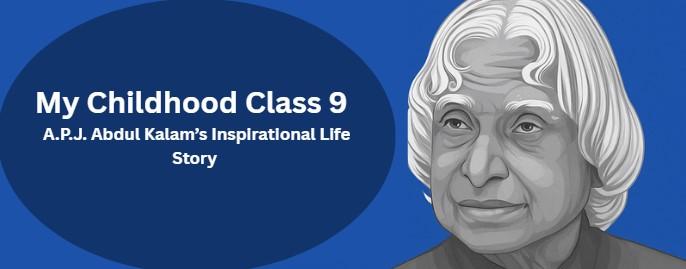
"My Childhood" is an inspiring extract taken from the autobiography "Wings of Fire" by Dr. A.P.J. Abdul Kalam, one of India's greatest scientists and the 11th President of India. Included as a chapter in the CBSE Class 9 English Beehive textbook, this lesson offers a glimpse into the early life of a humble boy from Rameswaram who went on to become the "Missile Man of India." This article "My Childhood Class 9 – A.P.J. Abdul Kalam's Inspirational Life Story" explores Kalam's upbringing, values, education, and lessons we can learn from his journey.
Dr. Avul Pakir Jainulabdeen Abdul Kalam was born on 15 October 1931 in the island town of Rameswaram, Tamil Nadu. His father Jainulabdeen was a boat owner, and his mother Ashiamma was a homemaker. Though the family was not wealthy, they lived a life of contentment, discipline, and simplicity.
The chapter gives us a first-person narrative of Kalam's early life. It tells us about his home, parents, friends, teachers, and the strong secular values that influenced him deeply. His upbringing was rooted in Indian tradition, respect for all religions, and the value of education.
Kalam's father was a wise man who led a simple life. Despite not having a formal education or wealth, he was spiritually rich and believed in helping others. Kalam learned:
These values became the foundation of his personality and guided him throughout his life.
Kalam was an average student but a hard worker. He had a keen interest in mathematics and science. His early education took place at Rameswaram Elementary School and later at Schwartz High School in Ramanathapuram.
Despite limited resources, Kalam never let poverty become a barrier. He distributed newspapers in the morning to support his studies. This shows his strong willpower and determination to learn.
One of the most important themes of this chapter is religious harmony. Kalam had three close friends:
Their bond shows how children can look beyond religion and caste. However, Kalam also faced social discrimination. Once, a new teacher objected to Kalam, a Muslim boy, sitting with Ramanadha Sastry, a Brahmin. Sastry's father stood against this prejudice, which left a lasting impact on Kalam.
This incident taught Kalam the importance of equality, justice, and fighting discrimination.
Kalam deeply respected his teachers. He believed that great teachers can shape the future of students. One such influence was Sivasubramania Iyer, a science teacher and a free thinker.
Iyer invited Kalam for a meal at his house. His wife initially refused to serve Kalam because of his religion. But Iyer didn't give in to prejudice and later served him with his own hands. Eventually, even his wife changed her attitude.
This incident reinforced Kalam's belief in education, rational thinking, and social equality.
Kalam's story reflects India's diverse but unified culture. It teaches students to respect all religions and promote unity.
Education is shown as a tool to break barriers of caste and poverty. Kalam's thirst for knowledge was limitless.
No obstacle is big enough if you are committed. Kalam's success is proof that consistency and perseverance lead to greatness.
Positive influences can change one's path. Teachers and parents play a major role in shaping character.
The chapter teaches that social barriers must be broken for true progress.
A: Kalam's upbringing teaches the values of simplicity, honesty, hard work, and religious tolerance.
A: A teacher humiliated him for sitting with a Brahmin boy. However, the boy's father protested, which reaffirmed Kalam's belief in justice.
A: He distributed newspapers to earn money and support his studies.
A: He believed in equality and courageously stood against religious discrimination.
A: It highlights the secular and inclusive fabric of Indian society.
"Dream is not that which you see while sleeping; it is something that does not let you sleep."
"If you want to shine like a sun, first burn like a sun."
The lesson "My Childhood Class 9 – A.P.J. Abdul Kalam's Inspirational Life Story" offers more than just a glimpse into the life of a great man. It teaches timeless values such as hard work, equality, humility, and the power of education. Kalam's life proves that greatness is not born, but achieved through strong values and determination.
Understanding this chapter helps students grasp how one's roots, relationships, and values shape the journey to success. It is a lesson in humanity, integrity, and resilience, which is why this chapter continues to inspire generations.
By studying "My Childhood," students not only appreciate Kalam's achievements but also learn the importance of leading a meaningful and value-based life.

 Like| 1

 Comment





Candidates who want to pursue computer engineering usually start their preparation early as they have to crack the toughest competitive exams like JEE

544 followers

As a student, you might often wonder why some students do exceptionally well in studies and co-curricular activities, all at the same time. While

103 followers
Examination is something we often look upon with fear. This is because either we lack confidence,are lazy for preparation or simply believ

17 followers

Chapter 1 of the CBSE Class 9 English textbook Beehive, titled "The Fun They Had" by Isaac Asimov, is a thought-provoking short story that takes reade
1254 followers

Name of Post : Jharkhand Board Class 9th Result 2020 Result date : 02 June 2020 Post Information : JAC Board, Ranchi Annual Board Examination

750 followers
Being the innocent toddlers who only had to eat, sleep and play was of immense fun. Growing up to the school going kids who need to complete their hom
17 followers

Reference link : https://en.wikipedia.org/wiki/Joseph_Fourier Jean-Baptiste Joseph Fourier (/ˈfʊrieɪ, -iər/;[1] French: [fuʁje]; 21 March 1768 – 1

175 followers

Making of the Indian Constitution The Making of the Indian Constitution is a monumental chapter in India's history. After centuries of colonial rule,
1254 followers


 Copy Link