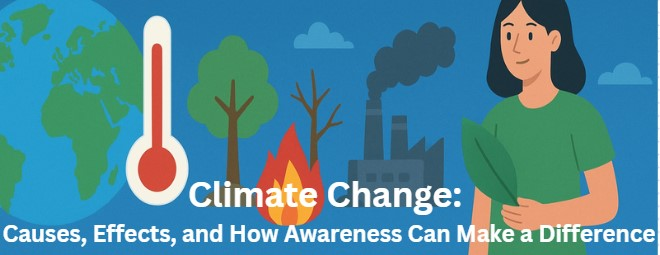
Climate change is one of the most serious challenges facing our planet today. Rising global temperatures, melting glaciers, unpredictable weather patterns, and increased carbon emissions are affecting every corner of the Earth. While many people hear about climate change, only a few fully understand how deeply it impacts our lives and how awareness can help fight it.
This article explores the causes and effects of climate change and highlights how environmental awareness can inspire action toward a cleaner, greener, and safer world.
Climate change refers to long-term shifts in temperatures and weather patterns across the globe. While natural causes such as volcanic eruptions and solar activity have always influenced the Earth's climate, human activities—especially since the Industrial Revolution—have accelerated these changes to dangerous levels.
The burning of fossil fuels (coal, oil, and gas) releases large amounts of carbon dioxide (CO₂) and methane (CH₄) into the atmosphere. These gases trap heat, leading to the greenhouse effect, which causes the planet to warm up.
Understanding the causes of climate change is the first step toward solving it. Here are the main contributors:
Electricity generation, transportation, and industrial processes rely heavily on coal, oil, and natural gas. These energy sources emit greenhouse gases, mainly CO₂, which trap heat in the atmosphere.
Forests act as carbon sinks, absorbing CO₂ from the air. However, large-scale deforestation for agriculture, urbanization, and timber reduces this natural absorption, releasing stored carbon back into the atmosphere.
Factories and manufacturing units release not only CO₂ but also harmful pollutants like nitrogen oxides and sulfur dioxide. These gases contribute to both air pollution and global warming.
Farming produces methane (from livestock digestion) and nitrous oxide (from fertilizers). These gases are more potent than CO₂ and significantly contribute to climate change.
Poor waste disposal, especially in landfills, generates methane. Additionally, plastic waste releases toxic gases when burned, worsening air pollution and warming.
Vehicles powered by petrol and diesel are among the largest sources of carbon emissions globally. The growing number of cars and airplanes has intensified the problem over the past few decades.
The consequences of climate change are already visible. Scientists warn that if global temperatures continue to rise, the effects will become irreversible. Here are some key impacts:
The Earth's average surface temperature has increased by more than 1°C since the late 19th century. This may seem small, but it has drastic effects on ecosystems and weather.
Glaciers and polar ice caps are melting faster than ever. This contributes to rising sea levels, which threaten coastal cities and small island nations.
Heatwaves, floods, droughts, hurricanes, and wildfires are becoming more frequent and intense. These disasters destroy homes, farmland, and infrastructure.
Many plants and animals are struggling to adapt to rapid environmental changes. This leads to habitat loss and the extinction of vulnerable species.
Changing rainfall patterns affect crop yields. Some regions face droughts, while others experience floods, making food production unpredictable.
Climate change increases respiratory problems, heat-related illnesses, and the spread of infectious diseases. Poor air quality and extreme heat especially affect children and the elderly.
Natural disasters, crop failures, and health crises strain economies worldwide. Developing countries face the hardest challenges due to limited resources and infrastructure.
While the problem is global, the solution starts locally—with awareness and education. Environmental awareness means understanding how our daily actions affect the planet and taking responsibility to reduce that impact.
When people understand how their behaviors—like energy use or waste disposal—affect the environment, they are more likely to make sustainable choices.
Awareness campaigns can promote recycling, energy conservation, and eco-friendly transportation. These small actions, when adopted widely, lead to large-scale change.
Students and young people play a vital role in spreading awareness. School programs, eco-clubs, and community clean-up drives create a strong sense of responsibility toward nature.
Awareness increases public support for environmental policies, green technology, and renewable energy projects. When people demand action, leaders respond faster.
By understanding the concept of a “carbon footprint,” individuals can measure and reduce their impact through lifestyle adjustments like carpooling, using renewable energy, and minimizing plastic use.
Switching from fossil fuels to renewable energy sources like solar, wind, and hydroelectric power can drastically cut emissions. Awareness campaigns can help people and businesses adopt these alternatives.
Planting trees remains one of the simplest yet most effective solutions. Community tree drives not only absorb CO₂ but also restore habitats and improve air quality.
Consumers can influence markets by choosing sustainable brands and reducing single-use plastics. Awareness pushes companies to become more environmentally responsible.
Schools and colleges should include environmental education in their curriculum. The more informed young people are, the more likely they'll take conscious actions as adults.
Social media, blogs, and digital campaigns are powerful tools to share environmental messages and motivate global participation.
You don't have to be a scientist or activist to fight climate change. Every small effort matters. Here are practical ways to contribute:
Governments and organizations worldwide are taking steps to slow global warming. Some key initiatives include:
These collective actions show that when awareness translates into policy, meaningful change becomes possible.
Climate change is not just an environmental issue—it's a human issue that affects our health, economy, and future generations. The good news is that we still have time to act. Understanding the causes and effects of climate change helps us make informed choices, while environmental awareness empowers individuals and communities to take responsibility.
Every decision—whether it's conserving energy, planting a tree, or spreading knowledge—contributes to a sustainable future. The fight against climate change begins with awareness, but it succeeds through action. Together, we can make a difference for our planet and the generations yet to come.

 Like| 1

 Comment





 461 Enrollment
 Validity Unlimited


Well if you are planing to target UPSC 2020 Exam, than you should need to go for Daily news analysis with the help of this article we are trying to ma
1012 followers
Difference between LOC and LAC: LOC का फुल फॉर्म है लाइन ऑफ़ कण्ट्रोल जिसका हिंदी अर्थ है ‘नियंत्रण रेखा’. जबकि LAC का फुल फॉर्म है लाइन ऑफ़ एक्चुअल कण्

13 followers

The UPSC conducts the Engineering Services Exam (ESE) once a year to provide various job opportunities to engineering graduates. The level of this exa

17 followers

UPSC exam has been a difficult task for candidates pursuing to become the owner of the ultimate civil services. IAS exam tests aspirants' calibre at e

3 followers

In the current situation, many exams have either been postponed or no one knows when they will be conducted. In this pandemic, under
32 followers

UPSC Mains (Civil Services) 2020 communicating to be in 2020. UPSC 2020 notification has already free the UPSC Mains Admit Card 2020 on the officia
1012 followers
आंध्र प्रदेश (एपी) के राज्यपाल विश्वभूषण हरिचंदन ने 31 जुलाई 2020 को राज्य सरकार के तीन राजधानी वाले योजना को मंजूरी दे दी है. आंध्र प्रदेश की जगनमोह

30 followers

World history is very important topic if you are targeting for UPSC 2020 exam because it has been seen that every year in UPSC exam the amount of q
1012 followers


 Copy Link