Students in Class 11 and Class 12 often face one of the most challenging academic phases of their lives. They must manage school studies, board exam preparation, and competitive exams at the same time. Without proper planning, it becomes difficult to balance everything effectively. This is why creating the best study timetable for Class 11 & 12 students is essential for academic success.
A well-structured timetable helps students stay disciplined, manage time efficiently, reduce stress, and cover the syllabus in a systematic way. Whether you are preparing for board exams or competitive exams like Joint Entrance Examination and National Eligibility cum Entrance Test, having a proper study schedule can make preparation easier and more effective.
This detailed guide explains how to design the best study timetable, how many hours to study, and strategies that help Class 11 and 12 students stay productive.
Many students believe studying longer hours guarantees better marks. In reality, success depends more on consistency and planning than simply studying for long periods.
A good study timetable offers several benefits:
Students can divide time between school subjects, revision, practice tests, and relaxation.
A timetable ensures that all subjects receive proper attention instead of focusing only on favorite topics.
Planning in advance prevents last-minute panic before exams.
Daily study routines build discipline and long-term focus.
Regular revision and practice improve understanding and exam scores.
One of the most common questions students ask is how many hours they should study daily. The answer depends on individual learning capacity, but a balanced schedule usually includes:
In total, 5–7 hours of focused self-study daily is usually sufficient for most students preparing for board exams and entrance exams.
Quality study matters more than quantity.
Below is an example of a balanced study schedule that students can follow.
Morning hours are ideal for studying difficult subjects because the mind is fresh and more focused.
Recommended activities:
Morning study improves concentration and helps retain information longer.
During school hours, students should focus on:
Active learning during school reduces the burden of studying the same topics again later.
After school, students should take some time to relax.
Healthy activities include:
Rest is important because studying continuously without breaks reduces productivity.
This is one of the most productive study sessions of the day.
Suggested activities:
Students preparing for competitive exams can also practice questions related to entrance exam patterns.
Taking proper breaks between study sessions improves focus. Students should relax, spend time with family, or take a short walk.
Night study sessions are ideal for:
Students should avoid extremely late-night studying because sleep is essential for memory and concentration.
Adequate sleep is extremely important. Students should aim for 7–8 hours of sleep daily.
Lack of sleep leads to poor concentration, reduced memory, and lower productivity.
Instead of studying the same subjects every day, students can rotate subjects throughout the week.
Example weekly structure:
Weekly rotation prevents boredom and ensures balanced preparation.
Revision is one of the most important parts of exam preparation. Many students study topics once and move on without revisiting them.
Effective revision methods include:
Regular revision helps students remember concepts for a longer period.
Practicing previous year question papers helps students understand:
For board exams like Central Board of Secondary Education, solving past papers significantly improves exam performance.
Students should attempt at least one practice paper every week during exam season.
Students preparing for entrance exams must balance both board and competitive exam preparation.
Key strategies include:
Conceptual understanding helps in both board exams and competitive exams.
Entrance exams focus on analytical and problem-solving skills.
For example, studying physics chapters for boards also supports engineering or medical entrance preparation.
A timetable works best when combined with effective study techniques.
Instead of reading passively, students should:
Study for 25–40 minutes, then take a 5–10 minute break.
This technique improves concentration and prevents mental fatigue.
Using diagrams and mind maps helps understand complex topics faster.
Many students create unrealistic timetables that they cannot follow consistently.
Common mistakes include:
A timetable should be flexible and practical.
Creating a timetable is easy, but following it consistently is the real challenge.
Helpful tips include:
Start with achievable daily targets.
Avoid unnecessary mobile usage during study time.
Maintain a daily checklist of completed tasks.
Reward yourself after completing study goals.
A good study timetable also includes healthy habits.
Students should focus on:
Physical health directly affects mental performance and concentration.
Here is a simple timetable example.
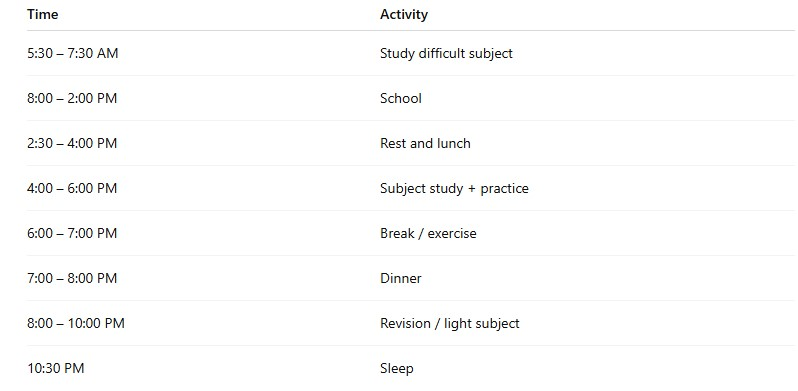
Students can modify this schedule according to their needs.
Class 11 and Class 12 are crucial years that shape a student's academic future. With proper planning and disciplined study habits, students can manage both board exams and competitive exams effectively.
Creating the best study timetable for Class 11 & 12 students helps maintain consistency, reduce stress, and improve academic performance. The key is not studying for extremely long hours but studying smartly and regularly.
By following a structured timetable, revising regularly, practicing previous year questions, and maintaining a healthy lifestyle, students can achieve excellent results and confidently prepare for future academic challenges.

 Like| 5

 Comment





 0 Enrollment
 Validity 11 month,26 days
The Central Board of Secondary Education (CBSE) conducts board examinations for class 10th, 11th and 12th. 10th boards are necessary as they give you

469 followers

The CBSE board organizes and conducts examinations for the 10th class students. The students often wonder what course to choose after the 10th class.
469 followers

Genetics and Evolution Genetics and evolution are fundamental concepts in biology that explain the diversity of life on Earth and how organisms ad
1253 followers

The National Eligibility cum Entrance Test (NEET) or NEET (UG), is a national level exam which is conducted by the National Testing Agency. This exam

123 followers

Skill-Based Education in India Education in India is evolving rapidly. Traditional learning methods focused mainly on theoretical knowledge, but mode
1253 followers
Even though the registration for NEET 2020 will begin from 2nd December 2020, the buzz for NEET prep has already started among the students aspiring f
123 followers

Mental health issues are increasing significantly not just in India but throughout the world. One of the major reasons behind such a sudden rise is th

16 followers

Chemistry holds a very important position in NEET Exam, so make your strategy accordingly with reference to topics. Here is one of the important topic
123 followers


 Copy Link