Understanding Force and Laws of Motion is essential for mastering Class 9 Science. This chapter forms the foundation for many real-world physical concepts and is directly linked to higher-grade physics. In this article, we provide complete notes, key NCERT solutions, formulas, and important concepts to help you prepare effectively.
The chapter “Force and Laws of Motion” explains the behavior of objects when forces act on them. It introduces concepts like inertia, force, mass, and acceleration, and focuses heavily on Newton's Laws of Motion.
A force is a push or pull that changes or tends to change the state of rest or motion of an object.
Effects of Force
1. Balanced Forces
2. Unbalanced Forces
First Law: Law of Inertia
An object remains at rest or in uniform motion unless acted upon by an external unbalanced force.
This law introduces the concept of inertia – the tendency of an object to resist a change in its state.
Inertia depends on mass: Greater the mass, greater the inertia.
Example: Passengers fall forward when a bus suddenly stops.
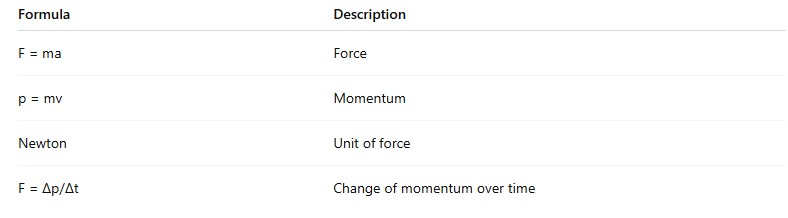
Second Law: F = ma
The rate of change of momentum is directly proportional to the applied force and takes place in the direction of the force.
Mathematically:
F = ma
Where:
F = force (N),
m = mass (kg),
a = acceleration (m/s²)
Important Note:
1 N = Force required to accelerate 1 kg mass by 1 m/s²
Third Law: Action and Reaction
For every action, there is an equal and opposite reaction.
These forces act on two different bodies and are simultaneous.
Examples:
“The total momentum of an isolated system remains constant if no external force acts on it.”
p = mv
SI Unit: kg·m/s
For two objects:
Q1: Calculate the force required to accelerate a 5 kg mass by 2 m/s².
Solution:
F = ma = 5 × 2 = 10 N
Q2: A bullet of mass 0.01 kg is fired with a velocity of 500 m/s. Find its momentum.
Solution:
p = mv = 0.01 × 500 = 5 kg·m/s
Q1. Why do athletes run some distance before taking a long jump?
Answer: To gain inertia of motion, which helps them jump farther by increasing their momentum.
Q2. Explain why a horse cannot pull a cart and run in empty space.
Answer: In empty space, there's no reactionary force to push the cart forward. Newton's third law fails due to lack of contact forces.
Q3. A 2 kg object is moving with a velocity of 4 m/s. What is its momentum?
Answer:
p = mv = 2 × 4 = 8 kg·m/s

1. Write Newton's three laws of motion.
2. A 10 kg object is accelerated by 3 m/s². Calculate the force.
3. What is the momentum of a car of mass 1200 kg moving at 20 m/s?
4. Define and give examples of unbalanced forces.
The chapter Force and Laws of Motion provides a vital understanding of how forces interact with bodies to cause changes in motion. Newton's laws form the core of classical physics, and questions from this chapter are common in CBSE exams, Olympiads, and NTSE.
If you want to go one step further in understanding motion in depth, you should also check out our article on:
Motion Class 9 – Notes, Formulas, Diagrams & NCERT Solutions
This companion chapter lays the groundwork for motion that is built upon in "Force and Laws of Motion." Together, both chapters give a comprehensive understanding of the physics of everyday movement and interaction.

 Like| 1

 Comment





 0 Enrollment
 Validity 2 month,29 days

Matter in Our Surroundings "Matter in Our Surroundings" is the first chapter of the Class 9 Science NCERT textbook. This chapter introduces students
1253 followers
Without need, the invention would not be possible and without invention , life would not be so easy and comfortable as it is in the current time. Fr

25 followers

Why Do We Fall Ill In CBSE Class 9 Science, Chapter 13 titled "Why Do We Fall Ill" deals with the basic concepts of health and disease. It focuses on
1253 followers
Earlier being tech-savvy was only referred to the computer geeks or internet wizards. But today with the enhancement in the field of techn

17 followers
Note making is something that has been overlooked by students as there is not much of emphasis on it given by parents or teachers. However it is a pro
17 followers
Examination is something we often look upon with fear. This is because either we lack confidence,are lazy for preparation or simply believ
17 followers

The role of parents in their child’s education is vital. Children tend to imitate and learn from their environment and surroundings. Hence, to ensure
544 followers

Student life is not only tough but is full of distractions such as from attending school and coaching to preparing for half-yearly exams and to spare
544 followers


 Copy Link