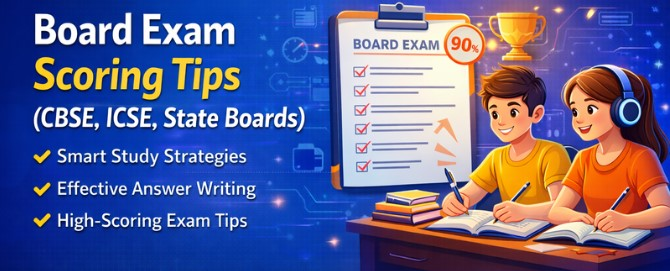
Board examinations are one of the most important milestones in a student's academic journey. Whether you are studying under the Central Board of Secondary Education, the Council for the Indian School Certificate Examinations, or any state education board, scoring high marks in board exams requires the right preparation strategy, consistent practice, and smart exam techniques.
Many students work hard throughout the year but still struggle to achieve the marks they expect. The reason is often not lack of effort but lack of the right approach. In this detailed guide, you will learn proven board exam scoring tips for CBSE, ICSE, and State Board students that can help you improve your preparation and perform better in exams.
Board exams play a significant role in shaping a student's academic future. The marks obtained in these exams are often considered for:
For students in Class 10 and Class 12, board exams also test conceptual understanding, writing skills, and time management.
Because of this importance, students need a structured study plan and effective strategies to maximize their scores.
Before starting preparation, students should understand the exam pattern and marking scheme. Each board exam follows a specific format that determines how marks are awarded.
For example:
Understanding the pattern helps students focus on the most important areas of the syllabus and prepare accordingly.
Students should carefully analyze:
This gives a clear idea of what topics are frequently asked in exams.
One of the most effective board exam preparation tips is creating a proper study schedule.
A well-planned timetable helps students:
Instead of studying randomly, students should divide their time between subjects based on difficulty and importance.
Morning session
Afternoon session
Evening session
Night session
Consistency is more important than studying for extremely long hours.
Memorizing answers without understanding the concept rarely helps in board exams. Modern exam papers are designed to test understanding rather than rote learning.
Students should focus on:
Concept clarity makes it easier to answer even unfamiliar questions in the exam.
For science and mathematics subjects, solving numerical problems regularly improves both speed and accuracy.
Practicing previous year papers is one of the most powerful strategies for board exam preparation.
Benefits include:
Students should solve at least 5 to 10 previous year papers before the final exam.
While solving these papers, students should simulate real exam conditions by setting a timer and avoiding distractions.
Even if students know the correct answer, poor presentation can reduce marks.
Examiners evaluate not only the content but also how clearly the answer is written.
Clear presentation makes it easier for examiners to understand answers and award marks.
Revision is one of the most crucial parts of exam preparation. Many students finish studying the syllabus but fail to revise it effectively.
To retain information for a long time, students should revise topics multiple times.
Regular revision strengthens memory and improves recall during exams.
In subjects like biology, geography, and science, diagrams play an important role in scoring high marks.
Drawing neat diagrams:
Students should practice drawing important diagrams during preparation so that they can reproduce them quickly in exams.
Many students lose marks not because they don't know the answers but because they run out of time.
Proper time management in the exam hall is essential.
This approach ensures that all questions are attempted within the allotted time.
Certain mistakes can reduce marks even if preparation is good.
Common mistakes students make include:
Being aware of these mistakes helps students avoid them during exams.
Physical and mental health play an important role in academic performance.
Students should maintain a balanced lifestyle during exam preparation.
A healthy body supports better concentration and memory.
Many education boards release sample papers to help students prepare.
Solving sample papers helps students:
Mock tests also help reduce exam anxiety because students become familiar with the exam environment.
Board exam preparation requires discipline and consistency. Instead of studying intensely for a few days and then losing focus, students should maintain a steady routine.
Motivation can be maintained by:
Positive mindset and determination help students stay focused until the exams are over.
The final month before board exams is crucial. Students should focus mainly on revision and practice during this period.
Avoid starting completely new topics at the last minute unless they are very important.
The day before the exam should be used for light revision and mental preparation.
Students should:
Proper rest before the exam helps maintain focus during the test.
On the exam day, students should remain calm and confident.
Helpful exam day tips include:
Confidence and clarity of thought are essential for performing well in exams.
Scoring high marks in board exams is not just about studying hard but also about studying smart. By following the right strategies, managing time effectively, and maintaining consistent study habits, students can significantly improve their performance.
These board exam scoring tips for CBSE, ICSE, and State Board students focus on concept clarity, regular revision, effective answer writing, and smart exam strategies. When combined with dedication and disciplined preparation, these techniques can help students achieve excellent results.
Board exams are an opportunity to demonstrate your knowledge and hard work. With proper planning and confidence, every student has the potential to perform well and achieve their academic goals.

 Like| 5

 Comment





 0 Enrollment
 Validity 11 month,25 days


Due to the spread of pandemic COVID-19, CBSE had to postpone its left over exams. Recently the Central Board of Secondary Education (CBSE) has release

Learn N Share - Get latest upd
2017 followers

Becoming an engineer is a dream for many students. As soon as a student steps into college, all he dreams about is cracking the IIT JEE ex

17 followers

Every parent wants the best for their child. Good schools effectively help their students to mold their future toward success. They provide an enrichi

1 followers

Candidates who want to pursue computer engineering usually start their preparation early as they have to crack the toughest competitive exams like JEE

544 followers
Subject-Wise Answer Keys for Board Exams & Competitive Tests Whether you're preparing for CBSE Class 10, Class 12, or competitive exams like NEET, JE

8 followers

What is Environment The environment encompasses everything around us. It includes all living and non-living things, interacting with each other in a
1253 followers

विश्व उपभोक्ता अधिकार दिवस: 15 मार्च (World Consumer Rights Day: March 15) विश्व भर में आज विश्व उपभोक्ता अधिकार दिवस मनाया जा रहा है। दुनिया

3189 followers

What is Coordination Compounds Coordination compounds, also known as coordination complexes, are an essential class of chemical compounds where a
1253 followers


 Copy Link